Henry Clay Quotes
I do not think that the subject of slavery ought to affect the question, one way or another. Whether Texas be independent, or incorporated in the United States, I do not believe it will prolong or shorten the duration of that institution. It is destined to become extinct, at some distant day, in my opinion, by the operation of the inevitable laws of population. It would be unwise to refuse a permanent acquisition, which will exist as long as the globe remains, on account of a temporary institution.
This remarkable quotation shows that this great Southern leader, 15 years before the Civil War, publicly stated that the institution of slavery was doomed to extinction. As such it was not worth worrying about in such issues as new territories of the Union and other more important and long lasting things. This quotation however is not commonly cited.
Henry Clay, 1777-1852, U.S. Congressman and Senator (National Republican & Whig, KY), Speaker of the House, U.S. Secretary of State, Letter to The Tuscumbia North Alabamian, July 25, 1844
Sourced by: Eigen's Political and Historical Quotations

While England was strongly opposed to slavery, the English textile industry benefited from importing American Southern cotton. So many in England were supportive of the Confederacy.


The National Enquirer was originally a serious abolitionist newspaper, not the sensationalist tabloid it became in modern times.

Baldwin was a young lawyer at the time. He represented a shipload of ex-slaves who had taken over their Spanish slave ship and landed in America. The Spanish claimed, the ship owners and some of the crew all claimed the “property.”

The first anti-slavery newspaper published in the United States & the first journal in America to advocate immediate, unconditional emancipation

In this quotation Lincoln got out of the rhetorical trap that Douglas had set for him by disclosing his personal preferences as opposed to the positions that Douglas had accused him of being pledged to. See {615827}.

For more about the Bureau. See {629185}.and {629187}.

Even before we had a Constitution there was major opposition to slavery. The “price” of the American Union was the acceptance of the slavery of the South. But the hypocrisy of a country based on liberty to allow and enforce slavery was not lost on the founding fathers. Ironically the abolitionists among the founding fathers were certain that they could persuade the Southern slaveholders of the error of slavery in a few years and things would be set right in the land. Even George Washington {630626}, and Thomas Jefferson and some other slaveowners at the time wished to see its abolition. Slaveholding Southern Founding Fathers in general were so wary of the abolitionists that they achieved structural, disproportionate, power in the new Constitution to ward off the abolitionists attempts to reform slavery.
Note that Lincoln did not justify the emancipation proclamation on moral or humanitarian grounds, but on the grounds of military necessity.
Most people do not realize that the best economic argument for retaining American slavery was made by the Father of Communism himself. What Marx did not realize was how rapidly the Northern States were industrializing and how much science and technology was bushing society ahead economically. However, 15 years later, when slaves began to be emancipated, the world had changed again, and the North thrived economically and every other way without the “contribution” of the products of Southern slavery. It may have been however that in 1848, America could not have fared so well without slavery, but 1861 was a different economic era.

It was in fact, the following year when the South rebelled to prevent a “settlement”, but the irony was that the Civil War brought the settlement—emancipation-- faster and on less favorable terms than had they not rebelled and let the political process end slavery gradually as the majority of the nation wanted and morality dictated.

This Civil War recruiting poster was described by the Free Library of Philadelphia as “Civil War recruitment print targeting African Americans by evoking the freedoms granted by the Emancipation Proclamation. Depicts a montage of symbolic scenes centered around an African American Union soldier triumphantly holding up a sword and an American flag with the banner "Freedom to the Slave." He stands near broken shackles upon a tri-color flag adorned with a coiled snake. The flag is tugged upon by one of three joyous slaves freed by an African American soldier. Other scenes depict an African American man reading a newspaper on a rocking chair near a plow and child, African American children entering a "Public School" near a church, and a regiment of "U.S. Colored Troops" marching across a battlefield strewn with dead bodies.”
See {633926} for a quotation from the text that transmitted the resolution.
This was America’s first emancipation of slaves. It was not done so much for the principle of equality or rights of slaves, but as an intimidation technique applied to the rebellious Americans.
The Czar of Russia was often referred to as “The Autocrat of all the Russians” He was the most entrenched and powerful monarch in the world with absolutely no possibility of his giving up his crown and power. That was the analogy that Lincoln used here to express his pessimistic view that the Southern slave owners would never voluntarily give up their slaves. He was right of course in both cases. Force during and after the Civil War freed the slaves, and the 1917 Russian Revolution ended the Czar’s reign.

At the time most people did not realize that the ability of a nation or land area to support a population was dependent more on agricultural and industrial productivity than on population size. In the most affluent and developed countries, land outside of the cities is quite affordable and available, whereas in poor, underdeveloped nations, land distribution and reform is still a factor. The majority of citizens of many developed, affluent nations do not own any land.

America’s first political economist
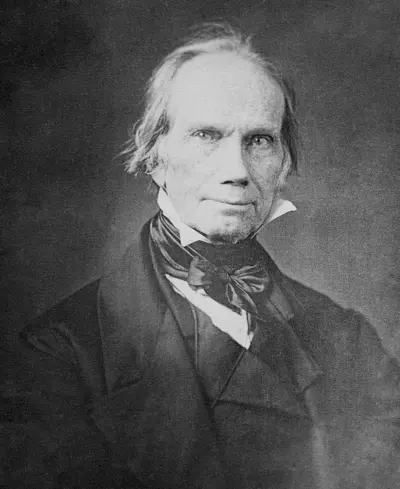
Henry Clay Sr. was an American attorney and statesman who represented Kentucky in both the Senate and House. He was the seventh House Speaker and the ninth Secretary of State. He received electoral votes for president in the 1824, 1832, and 1844 presidential elections. He also helped found both the National Republican Party and the Whig Party. For his role in defusing sectional crises, he earned the appellation of the "Great Compromiser" and was part of the "Great Triumvirate".
