Karl Marx Quotes
Without slavery, North America, the most progressive nation, would be transformed into a patriarchal country. Only wipe North America off the map and you will get anarchy, the complete decay of trade and modern civilization. But to do away with slavery would be to wipe America off the map.
Most people do not realize that the best economic argument for retaining American slavery was made by the Father of Communism himself. What Marx did not realize was how rapidly the Northern States were industrializing and how much science and technology was bushing society ahead economically. However, 15 years later, when slaves began to be emancipated, the world had changed again, and the North thrived economically and every other way without the “contribution” of the products of Southern slavery. It may have been however that in 1848, America could not have fared so well without slavery, but 1861 was a different economic era.
Karl Marx, 1818-1883, German Economist & Socialist, Letter to Pavel Annekov, December 28, 1846
Sourced by: Eigen's Political and Historical Quotations

Jefferson was an enigma with respect to slavery. Whereas he always abhorred it in his writings, and argued for an end to slavery, he maintained slaves himself and never did free them, unlike Washington, who spoke on the subject much less, but left orders in his will that all slaves were to be set free.


While England was strongly opposed to slavery, the English textile industry benefited from importing American Southern cotton. So many in England were supportive of the Confederacy.

The Confederates had a strategy of obtaining material assistance, prestige and recognition from England during the civil war. Confederate diplomats reported favorable attitudes of English diplomats. However, Southern leaders were in absolute denial about and insensitive to the revulsion that most of Europe and the sophisticated nations felt about slavery at the time." 1st Viscount Lyons

The National Enquirer was originally a serious abolitionist newspaper, not the sensationalist tabloid it became in modern times.


Baldwin was a young lawyer at the time. He represented a shipload of ex-slaves who had taken over their Spanish slave ship and landed in America. The Spanish claimed, the ship owners and some of the crew all claimed the “property.”

In 1851 the Anti-Slavery Society of Canada was founded stimulating a major public debate in Canada. Although there was no slavery in Canada, there were sharp differences as to how overt Canadians should become in opposition to American slavery. Southern politicians pressured Canada not to interfere and objected to Canadians giving asylum to fugitive slaves. The hypocrisy of American principles of freedom and liberty with the institution of slavery was a favorite target of Brown’s speeches and writing.

American reformers followed slavery issues in Africa and elsewhere. The status of Africa was particularly important as the notion of extensive American Black colonization was still viable to many.

The country had been completely polarized by 1854. It was only a matter of time for something like the Civil War to break out. The impossibility of compromise was not just held by radicals like Garrison but after the Compromise of 1850 fell apart, most politicians on both sides s

The first anti-slavery newspaper published in the United States & the first journal in America to advocate immediate, unconditional emancipation
The first anti-slavery newspaper published in the United States & the first journal in America to advocate immediate, unconditional emancipation

In this quotation Lincoln got out of the rhetorical trap that Douglas had set for him by disclosing his personal preferences as opposed to the positions that Douglas had accused him of being pledged to. See {615827}.
The political conflict between the right of the slave to liberty and the right of the slave owner to his property made the immediate abolition of slavery very difficult after the Spanish had been overthrown in South America.
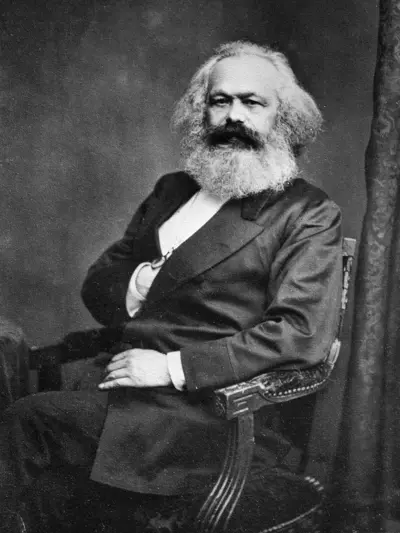
Karl Heinrich Marx was a German philosopher, economist, historian, sociologist, political theorist, journalist and socialist revolutionary. Born in Trier, Germany, Marx studied law and philosophy at university. He married Jenny von Westphalen in 1843. Due to his political publications, Marx became stateless and lived in exile with his wife and children in London for decades, where he continued to develop his thought in collaboration with German thinker Friedrich Engels and publish his writings, researching in the reading room of the British Museum. His best-known titles are the 1848 pamphlet The Communist Manifesto and the three-volume Das Kapital (1867–1883). Marx's political and philosophical thought had enormous influence on subsequent intellectual, economic and political history. His name has been used as an adjective, a noun, and a school of social theory.
