Mwanga Quotes
I am the last king of Buganda [Uganda]. The white men will take my country after my death. While I am alive I know how to stop them. But after me, there will be an end to the line of the Black kings of Buganda.
The king was right about the eventuality but wrong about his ability to keep his kingdom during his lifetime. The Arabs displaced him shortly thereafter. Mwanga was a notorious tyrant who constantly had his own people tortured and murdered. See Fredrick Holmwood.
Mwanga, *, Kabaka [King] of Buganda [Uganda], Statement to French Missionary, Father Lourdel, 1885
Sourced by: Eigen's Political and Historical Quotations


“Somsteu” was the name the Africans gave to Theophilus Shepstone, 1817-1893, British Colonial African Administrator.

He chronicled the early Portuguese entry into South-East Asia in the sixteenth century. Siam became Thailand.


Salisbury was Foreign Minister at the time.
Exploring large parts of Africa

The king knew the whites had designs on his kingdom. See Mwanga.

this is a joke Tutu has used, but variants of it exist which are not original to him.

She was one of the first prominent white southerners to denounce racial segregation.


Louis Napoleon Bonaparte. The “colonies” to which we was referring were the French Colonies in the Caribbean—particularly Haiti. The Black slaves had revolted against the slave-owners and had taken over all positions of authority and wore the uniforms and symbols of power including the epaulettes—the gold braid shoulder pieces that were symbols of high rank in military and diplomatic uniforms which were worn on all official occasions. Napoleon never did make good on his vow. He had many more problems with his own wars and governance in Europe. This quote does demonstrate the racism that existed in supposedly tolerant France.


He was driving through Tennessee and some white demonstrators were carrying racist signs insulting to Blacks. A companion asked what was the cause of Southern white racism.
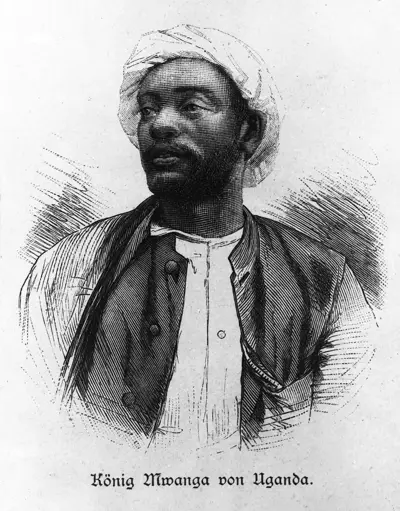
Danieri Basammula-Ekkere Mwanga II Mukasa was Kabaka of Buganda from 1884 until 1888 and from 1889 until 1897. He was the 31st Kabaka of Buganda.
