Benjamin Rush Quotes
While you are gazed at for your American-manufactured principles, and gazing at the folly and pageantry of animals in the shape of men cringing at the feet of an animal called a king, I shall be secluded from the noise and corruption of the times.
Benjamin Rush, 1745-1813, Physician & member of the Continental Congress, Surgeon General of the Continental Army and Treasurer of the U.S. Mint, Letter to John Adams, January 22, 1778
Sourced by: Eigen's Political and Historical Quotations


Ingersoll was considered to be the greatest orator and political thinker of his day, but his overt atheistic views curtailed his elected political career.


This is a variation of the famous Lord Acton quote {292904}.


"Imperium" is a Latin word which, in a broad sense, translates roughly as 'power to command'. In ancient Rome, different kinds of power or authority were distinguished by different terms "Imperium" referred to the sovereignty of the state over the individual—Wikipedia. The Consul was a wonderful diplomat. He had no respect for the South not only because they were fighting to maintain slavery, but also he found most of their diplomats and officials very incompetent. He found it hard to participate in all the Confederate ceremonies as he was their exhibit number one that they had International Recognition and they "exhibited him frequently. Despite this he was charming and never argumentative about slavery or other political positions that he loathed. As a matter of fact, the Southern Diplomats regarded him as a man sympathetic to the South with an understanding of their point of view. As a result he gained a huge amount of intelligence which he regularly dispatched back to London. England was neutral {35520} in the Civil War, but England did not recognize the Confederacy as a nation, else they would have sent an ambassador. The Southern politicians worked hard to get him to carry their message that if they would be recognized, they would grant England many favorable trade advantages as the English textile industry really wanted Southern cotton. While apparently sympathetic to the Southern cause, his reports contained all the negative information about the South and counseled against recognition just as the English Ambassador in Washington did—see {583131}.


These unfortunate characteristics of Germany at that time, produced the aggressive nation that started two world wars. Looking at Germany a century later, the country has changed radically—especially the three factors described in this quote. Germany has become very much like the rest of Western Europe and America.


The king was right about the eventuality but wrong about his ability to keep his kingdom during his lifetime. The Arabs displaced him shortly thereafter. Mwanga was a notorious tyrant who constantly had his own people tortured and murdered. See Fredrick Holmwood.
The Nationalist/Fascist views in the Spanish Civil War were so gross that they actually hurt the Nationalist cause in International opinion. See {592113} for another example. Despite the facts, most of the Western world was not then knowledgeable about the evils of Fascism and distrusted democracy, socialism, and communism more.

In 1927 there was a Peasant Uprising in the Hunan Province of China. Young Mau went there and wrote a report. Corruption has plagued China for millennia. As can be seen by this quotation, Mao thought that a “people’s revolution” would end corruption and despite capital punishment for corruption under the Communist government, corruption still thrived. By the 21st century corruption was common among local Communist Party Officials despite national party and government attempts to obliterate it.
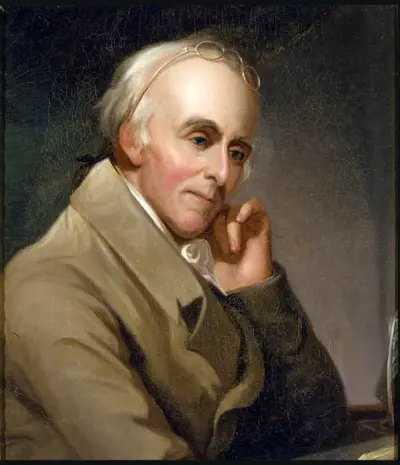
Benjamin Rush was a signer of the United States Declaration of Independence and a civic leader in Philadelphia, where he was a physician, politician, social reformer, humanitarian, and educator and the founder of Dickinson College. Rush attended the Continental Congress. His later self-description there was: "He aimed right." He served as Surgeon General of the Continental Army and became a professor of chemistry, medical theory, and clinical practice at the University of Pennsylvania.
