Edward Bates Quotes
I am neither North nor South. I repudiate political geography… I am a man believing in making laws and then whether the law is exactly to my liking or not, enforcing it—whether it be to catch a runaway slave and bring him back to his master or to quell a riot in a disordered territory.
Edward Bates, 1793-1869, Attorney General of the United States, U. S. Congressman (Republican, MO), Speech at the Whig National Convention, July 1856
Sourced by: Eigen's Political and Historical Quotations

What makes this quotation so historically interesting is that the abiding by the Supreme Court’s decisions on constitutionality was even an issue. It was because of the terrible Dred Scott decision which required Northern States to return fugitive slaves to their owners despite the constitutions of those states which stated that all men were free. A substantial part of the Democratic Party was the “solid South” and the return of fugitive slaves was one of the major issues of the 1860 Presidential Election. Ironically, the Southern States were arguing AGAINST states’ rights when the Northern States’ laws and Constitutions made fugitive slaves free the minute they set foot in the state.


In the entire history of the Supreme Court there have been relatively few times where the personal opinions and interests of the Supreme Court justices tended to warp the decision making process of the court. Perhaps the worst of these was the Dred Scott Decision where the court ruled that the laws of non-slave states could not protect escaped slaves no longer living in the South or their children for that matter. The slave owning court majority completely reversed their traditional support of states’ rights and voted that the Northern legal establishment could must not protect ex-slaves and must return them to their “rightful owners.” This decision made the Civil War inevitable. The slave owning justices were under great pressure, economic and social. Slaves, at the time constituted the greatest economic asset of the Southern states in dollar value. Further, at the time, there was no way to farm most Southern land without slaves, and even real estate values depended on slavery.

Northern laborers, especially the new Irish immigrants, were fearful of the prospect of competing for jobs with freed Negroes who they perceived would flock to the North. That is what happened but a century later. The blanket assumption that the South was pro slavery was also not accurate. Different sociologies and economics produced different attitudes in communities throughout the South and some were inclined to abolition as Rankin’s history demonstrates.

I should sooner remain in Southern bondage than avail myself of the opportunity of Northern freedom.
Hughes was a strong critic of the exploitation of laborers in the North by what he called the “bloated capitalist” First Irish Bishop in the United States


The Egyptian Army, responding to huge demonstrations, ordered the Muslim Brotherhood President to step down in what appeared to be a coup d’etat. There was an American law that required a cut off of foreign aid to any government that had come to power. The American Administration and most of Congress did not want to terminate foreign aid to Egypt, and announced that it could not come to a conclusion as to whether or not there was a coup. They did not say that there was no coups—they just decided not to decide. Since there was no finding of a coups, there was no cutoff. Senator Paul and a few other Senators, observing that there had been a coup, wanted the administration to cut off the foreign aid even though it would be detrimental to our foreign policy. The government must obey the law they argued, regardless of the consequences.

The Jury Trial was part of New York Law more than a century before the Constitution.


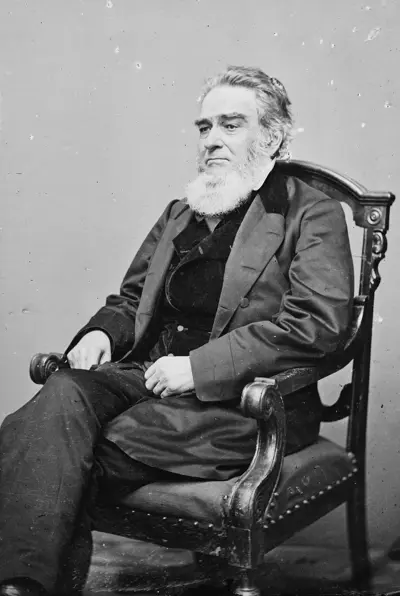
Edward Bates was an American lawyer and politician. He represented Missouri in the US House of Representatives and served as the US Attorney General under President Abraham Lincoln. A member of the influential Bates family, he was the first US Cabinet appointee from a state west of the Mississippi River.
