Thomas P.M. Barnett Quotes
Here's my favorite bonehead concept from the 1990s in the Pentagon: the theory of anti-access, area-denial asymmetrical strategies. Why do we call it that? Because it's got all those A's lined up I guess. This is gobbledygook for 'If the United States fights somebody, we're going to be huge. They're going to be small.'
Barnett, Thomas P.M. "Let's rethink America's military strategy." TED, Feb. 2005.


Although this may seem obvious to most, there has been, in recent years, an attempt by some to introduce the concept of proportionality into the war equation and definition of war crime. Defense after attack many argue should be proportional to the attack. So if Nation A shoots down a plane of Nation B, according to this logic Nation B is not supposed to invade nation A. Brecher points out the absurdity of the concept from a war point of view. It is however used by many to criticize the defenses against terrorism where modern weapons are used against terrorists and those that harbor them.


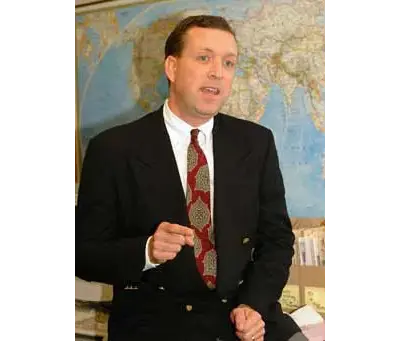
Thomas P.M. Barnett (born 1962) is an American military geostrategist and former chief analyst at Wikistrat. He developed a geopolitical theory that divided the world into "the Functioning Core" and the "Non-Integrating Gap" that made him particularly notable prior to the 2003 U.S. Invasion of Iraq when he wrote an article for Esquire in support of the military action entitled "The Pentagon's New Map" (which would later become the title of a book that would elaborate on his geopolitical theories). The central thesis of his geopolitical theory is that the connections the globalization brings between countries (including network connectivity, financial transactions, and media flows) are synonymous with those countries with stable governments, rising standards of living, and "more deaths by suicide than by murder". These countries form the Functioning Core. These regions contrast with those where globalization has not yet penetrated, which is synonymous with political repression, poverty, disease, and mass-murder, and conflict. These areas make up the Non-Integrating Gap.
