Washington Irving Quotes
The natural principle of war is to do the most harm to our enemy with the least harm to ourselves; and this of course is to be effected by stratagem.
Irving, Washington. A History of New York, from the Beginning of the World to the End of the Dutch Dynasty. Inskeep & Bradford, 1809, p. 248.


Although this may seem obvious to most, there has been, in recent years, an attempt by some to introduce the concept of proportionality into the war equation and definition of war crime. Defense after attack many argue should be proportional to the attack. So if Nation A shoots down a plane of Nation B, according to this logic Nation B is not supposed to invade nation A. Brecher points out the absurdity of the concept from a war point of view. It is however used by many to criticize the defenses against terrorism where modern weapons are used against terrorists and those that harbor them.

Very few societies ever had the wealth accumulated so that they could afford prolonged military operations. In addition, long, prolonged conflicts erode morale, both civilian and military. The Afghanistan War that went on for over a decade caused both and put a great strain on the U. S. national budget.


Later, he felt that the offense had become almost invincible. See {626741}. Tesla was one of the great American immigrant scientists. He found in America the kind of intellectual and operational freedom that did not exist in the rigid, monarch-controlled, Austro-Hungarian Empire. He developed patents and techniques that formed the technological bases of radio, telephone long distance, TV, cell phones, Wi Fi, just to name a few. Most important he was Thomas Edison’s great nemesis. Edison invented DC electric generators that could power factories or entire streets in a neighborhood. Tesler invented and developed AC electrical technology which could power entire cities and he could move electricity over long distances which Edison could not. Tesler was one of the first scientists to conceive of and try to implement “Big Science” where there were huge capital investments to develop machines and systems to do what had never been done before—philosophically like the CERN Hadron Collider. Tesler even convinced a large corporation to finance the construction of a massive building and tower so he could experiment with the wireless transmission of electricity. However, as the industrial democracies have learned, Big Science can only be funded by governments and it often takes sever working in consort to afford the huge investment that is required. In Tesler’s era, the federal and state governments did not fund scientific research so his work was not only technically ahead of his time but also conceptually. He anticipated most of the problems and need for a national power grid that was challenging America even at the beginning of the 21st century.

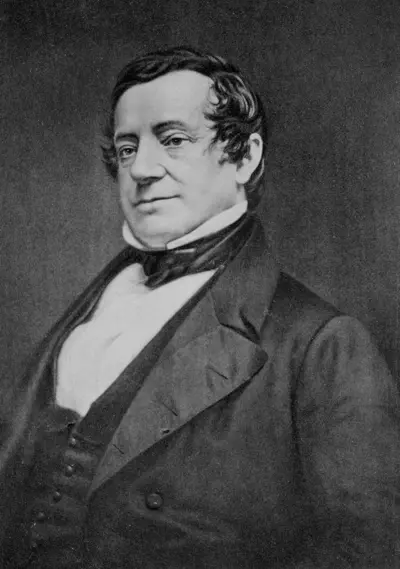
Washington Irving was an American short-story writer, essayist, biographer, historian, and diplomat of the early 19th century. He is best known for his short stories "Rip Van Winkle" (1819) and "The Legend of Sleepy Hollow" (1820), both of which appear in his collection The Sketch Book of Geoffrey Crayon, Gent. His historical works include biographies of Oliver Goldsmith, Muhammad and George Washington, as well as several histories of 15th-century Spain that deal with subjects such as Alhambra, Christopher Columbus and the Moors. Irving served as American ambassador to Spain in the 1840s.
