Themistocles Quotes
He who commands the sea has command of everything.
Cicero, Marcus Tullius. Letters to Atticus. Translated by E. O. Winstedt, vol. 2, William Heinemann, 1913, p. 317.


Nantucket was the center of the New England whaling fleet which at the time plied the Earth’s oceans and influenced non Western People the world over. It was a type of cultural imperialism although the whalers sized or claimed anyone’s land or controlled any nation’s trade.


This quotation illustrates several historical differences of the past with today. To be a world superpower, one had to have a dominant navy. Yet that navy was, in Churchill’s concept, a defensive system. It could protect the nation from invasion, and its merchant ships on the seas, but a navy provided no threat to invade towns and villages in Europe or elsewhere. Germany and France in contrast, with their large armies could invade other nations and menace Europe and Asia. It also illustrates why the navy and the army were considered completely separate departments of government in that they had different functions. The early American government had a Navy Department and Secretary but no Secretary of the Army or standing army.

Germany had a very small and insignificant navy. It was Tirpitz who persuaded the nation to develop sea power.


This historical quotation is important for two reasons, First, it shows us that the concept of a Canal was discussed fully a decade before Theodore Roosevelt actually had it built. Second, there were those who feared that a canal would actually be a detriment to the United States as our Navy was then quite weak. TR however built up the navy and made a great world-wide show of it and also built the Panama Canal.


Frederick the Great. He and many other Europeans thought that England had been so preoccupied with the American rebellion that she was ignoring Europe and other traditional foreign policy interests of theirs.


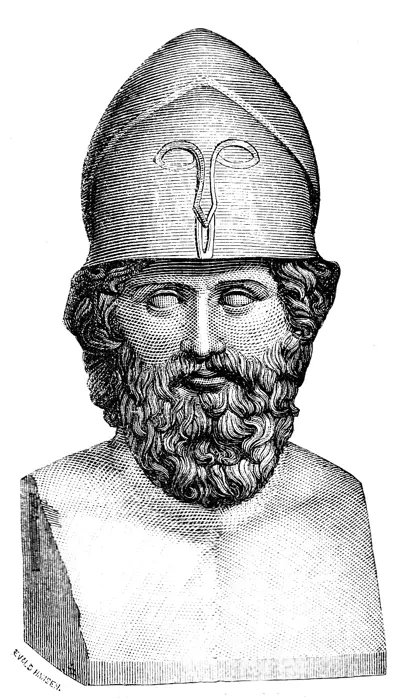
Themistocles (/θəˈmɪstəkliːz/; Greek: Θεμιστοκλῆς [tʰemistoklɛ̂ːs]; "Glory of the Law"; c. 524–459 BC) was an Athenian politician and general. He was one of a new breed of non-aristocratic politicians who rose to prominence in the early years of the Athenian democracy. As a politician, Themistocles was a populist, having the support of lower-class Athenians, and generally being at odds with the Athenian nobility. Elected archon in 493 BC, he convinced the polis to increase the naval power of Athens, a recurring theme in his political career. During the first Persian invasion of Greece he fought at the Battle of Marathon (490 BC) and was possibly one of the ten Athenian strategoi (generals) in that battle.
