Susan B. Anthony Quotes
Handcuffs. If you believe I am a common criminal for voting, then handcuff me.
The marshal was embarrassed by his assignment to arrest this famous, elderly woman. He refused to handcuff her, gave her time to change her clothes, and took Anthony by streetcar to the courthouse trying to keep as low a profile as possible while Anthony was making speeches all the way about her unjust arrest. She was found guilty and fined $100 which she never paid.
Susan B. Anthony, 1820-1906, Woman's Suffrage Leader, Statement to the Marshall who had come to arrest her for the crime of voting in a Congressional election
Sourced by: Eigen's Political and Historical Quotations


In 1639 the Maryland Assembly recorded what was probably the first American attempt to obtain the vote for women.


Opposing national attempts to give Blacks the vote in the South:


The law required voters to have a driver’s license or other picture ID issued by the Motor Vehicles Bureau. 300,000 adults in the state did not have a license. They tended to be more frequent among the poor, the elderly, and the minorities.


The classification of women with criminals and lunatics referred to the fact that at this time Women could not vote in New Zealand or any other nation of the world. The following year, much as a result of her efforts, New Zealand became the first country in the world to allow women to vote.


This phrase was also to be used over 100 years later by Malcolm X. See {624101} and {38291}.


Billinghurst was physically handicapped without the use of her legs. She protested and marched in protest parades using a hand propelled tricycle which the police sometimes dumped her out of and left her immobile in alleys.

First female presidential candidate & first divorcee to run for that office. The half to which she was referring were the females, who by many narrow laws were unable to participate in the intellectual and political life of the country. At the time, women could not even vote.

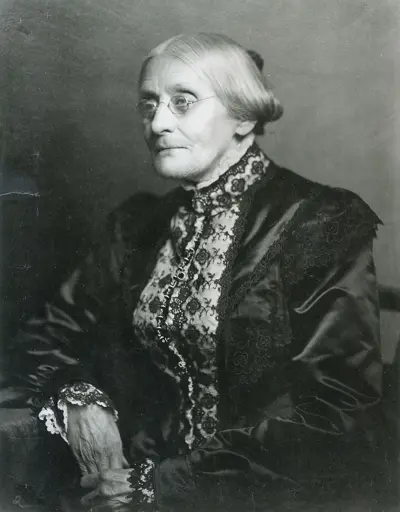
Susan B. Anthony was an American social reformer and women's rights activist who played a pivotal role in the women's suffrage movement. Born into a Quaker family committed to social equality, she collected anti-slavery petitions at the age of 17. In 1856, she became the New York state agent for the American Anti-Slavery Society.
