Nelson Rockefeller Quotes
Frank O’Conner is from New York City Frank O’Conner says the Subways should be free Guess who he wants to pay for them.
Rockefeller ran this ad throughout New York State but never ran the ad in New York City.
Nelson A. Rockefeller, 1908-1979, Governor of New York (Republican), Vice President of the United States, Campaign Ad, Gubernatorial Election 1966
Sourced by: Eigen's Political and Historical Quotations


He was the first mayor of New York City after the consolidation of the five boroughs into the City of Greater New York in 1898.


This was his common stump speech against his incumbent primary opponent. Florida at the time was one of the worst educational system and the rural population was uneducated and Smathers would pronounce “nepotism”, “thespian” and even “celibacy” with a lip curl that implied that they were perverted practices. Pepper’s sister-in-law worked in his office and hence, according to Smathers, Pepper practiced nepotism with his sister-in-law. Smathers oratory together with his uneducated constituency enabled him to attack and beat the popular Claude Pepper.

Jessie Helms was his young assistant who drafted this race baiting ad. There are two vicious but subtle aspects to this kind of attach ads. First, not that the ad does not address the problem of white men working along side of blacks. It only refers to wives and daughter. This interracial sex innuendo played on and increased the fear of whites that Blacks would commonly rape white women. The second nasty aspect of the ad is the specific attack on the opponent. Instead of saying that he favored desegregation, the phrase “mingling of the races” was used which implied that Graham was in favor of biracial intermarriage and children—again another sex innuendo. When integration of the workforce finally occurred in the South, there was no increase in Black men sexually assaulting white women. There has been a substantial increase in racial intermarriage however as racial bigotry has diminished in America.

This was a serious problem in major cities in the 1930s but became much worse over time as the cities grew and real estate values escalated. In modern times the problem even spread to affluent suburbs where the police, fire fighters, teachers, and other civil servants can often not afford to live in the community that they serve.

In the 2012 Presidential campaign, Mitt Romney castigated President Obama for cutting $730 billion from the very popular Medicare program in his budget. The cut did not reduce any benefits to Medicare recipients as the money was saved by ending a subsidy that had been paid to private insurance. However, in Romney’s proposed and published budget, he would cut Medicare by the same $730 but the cuts would come from services as the insurance companies would still get their subsidies.

The reason that this quotation is noteworthy is because it is one of the rare examples of a government program that succeeded despite predictions of disaster when it was debated and initiated. In this case, as in most others, for several months of contention Mayor Bloomberg was advocating placing thousands of free bicycles throughout the city where anyone can use them. Opponents were many and the most dire prediction was that all these bicycles in city traffic pedaled by un-vetted users who may have no skills would produce a large increase in death and injury. This produced heavy media coverage. Virtually every successful government program had opponents who predicted dire consequences. When most or all do not come true, there is usually no media coverage. This was one of the exceptions.


Nixon was the last Republican President in the 20th century to favor public transportation and mass transit. By the beginning of the 21st century, there were almost no Republican member of Congress would was interested in public transportation and most opposed all efforts at such.

He was the elected Mayor of London at the time.


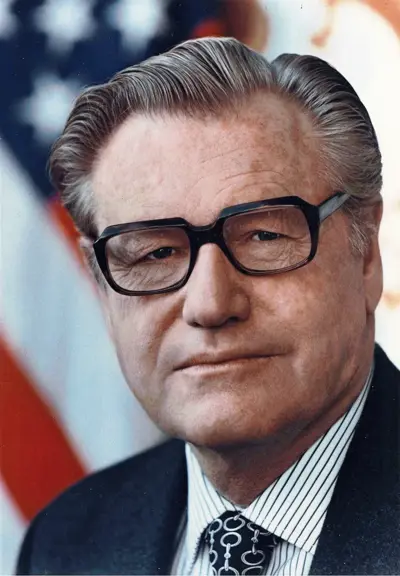
Nelson Aldrich Rockefeller was an American businessman and politician who served as the 41st vice president of the United States from December 1974 to January 1977, and previously as the 49th governor of New York from 1959 to 1973. He also served as assistant secretary of State for American Republic Affairs for Presidents Franklin D. Roosevelt and Harry S. Truman (1944–1945) as well as under secretary of Health, Education and Welfare under Dwight D. Eisenhower from 1953 to 1954. A grandson of billionaire John D. Rockefeller and a member of the wealthy Rockefeller family, he was a noted art collector and served as administrator of Rockefeller Center in Manhattan, New York City.
