New York Times Quotes
No Riders Killed in First 5 Months of New York City Bike-Share Program
The reason that this quotation is noteworthy is because it is one of the rare examples of a government program that succeeded despite predictions of disaster when it was debated and initiated. In this case, as in most others, for several months of contention Mayor Bloomberg was advocating placing thousands of free bicycles throughout the city where anyone can use them. Opponents were many and the most dire prediction was that all these bicycles in city traffic pedaled by un-vetted users who may have no skills would produce a large increase in death and injury. This produced heavy media coverage. Virtually every successful government program had opponents who predicted dire consequences. When most or all do not come true, there is usually no media coverage. This was one of the exceptions.
New York Times, Headline, November 4, 2013
Sourced by: Eigen's Political and Historical Quotations


He was the first mayor of New York City after the consolidation of the five boroughs into the City of Greater New York in 1898.


The queen was a lot more sophisticated about the newspapers than politicians in the 21st century.


This quotation appeared in the middle of an 1862 article on the Civil War written by the great writer, Nathaniel Hawthorne. The article had been mailed to the Atlantic Monthly editors in New York from Washington. There were a number of pages of descriptions of specific Cabinet Members and other politicians, their understanding of the issues in the war, and a description of how they spent their time, At the time, it was common for partisan newspapers and magazines to attack politicians of the other party. But the Atlantic, only 5 years old then was a very rare American publication. It was totally non partisan, artistic and literary as well as concerned with current and political events. It only ran articles of serious, (some argued elite) writers. Hawthorn’s material on the politicians was not very complimentary and would have been regarded by them and their supporters as a political attack. So the editors deleted the material that referred negatively to individuals, Their apology was as much to the author, Hawthorne—“our friend”—as it was to the readers. At the time, the New York Times, also non partisan, refrained from serious negative material about politicians and celebrities. This quotation shows us the journalistic and literary standards of the “better” publications of the time. To this day, even when running negative articles about politicians and celebrities, these publications will never use the extreme and sensational language of the New York Daily News, the Chicago Tribune, the New York Post, the National Inquirer, and many other “tabloid” type publications.

The bicycle rapidly became not only a major mode of American transportation but essentially was the catylist for the American tourist industry. This quotation illustrates the rapid change that tool –place with the popularity of this mode of transportation.

New transportation technologies required new laws, criminal and civil.


She has been both the most popular and the most criticized first lady in American History. She was the first lady for a longer period than any other as her husband was elected to 4 terms. Since he was crippled by polio and could not easily travel, she represented him and the nation at more events than any other First Lady. She was also very outspoken who areed with FDR on most issues but publicly differed on occasions. Further, she wrote more than any other First Lady, including a daily newspaper column, My Day, which appeared in many newspapers each day. This quotation came from one of her thousands of articles.


And the New York press is probably the most difficult and cynical in the world.
The 30,000 was far fewer than previous decades where automobile deaths had been constantly decreasing from a high of 50,000 a year.
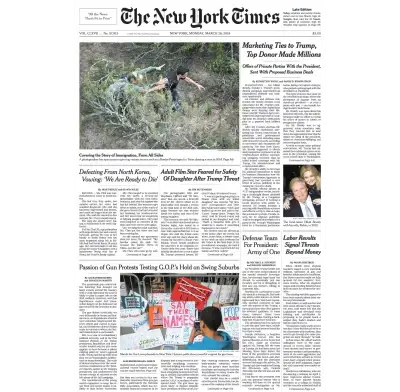
The New York Times (NYT or NY Times) is an American daily newspaper based in New York City with a worldwide readership. Founded in 1851, the Times has since won 130 Pulitzer Prizes (the most of any newspaper), and has long been regarded within the industry as a national "newspaper of record". It is ranked 18th in the world by circulation and 3rd in the U.S.
