Walter Scott Quotes
For monarchs seldom sigh in vain.
Scott, Walter. Marmion. Archibald Constable and Company, 1808, p. 251.


Sir Walter was imprisoned in the Tower of London for 13 years, during which time he turned to historical pursuits.


Drake named the land Nova Albion.

Gandhi was asked if the King had offered and encouragement for Indian Independence from England.

The early human idea that human rulers must somehow divine and/or designated and supported by the deity was present over many cultures and geographies.

She was Queen of Scotland and claimed the English throne as well. While Elizabeth I was on the throne of England, Mary claimed that the court had no jurisdiction over an absolute monarch. Her son was in France at the time but eventually succeeded to the Scottish throne as James VI and the English throne as James I.


Written after witnessing the excesses of the Court of King Charles II:

The two were cousins. Wilhelm was a very dominant personality and his cousin quite weak. This quotation shows the tyrannical view of the German Kaiser. The letters were secret but after the execution of the Czar, the Russians released the letters to show the dominant and warlike history of Germany under the Kaiser who was furious that the Russians had made such personal and secret letters public. The speech to which the Kaiser referred was one in which the Czar rejected all efforts to reform and limit his power—only driving more Russians to the revolutionary side. See the Czar’s quotation: {614054}

This newspaper was his communications outlet.

This is the most formalized and sophisticated compendium of laws of the so-called “barbaric peoples” of Europe. The compilation was in many ways a documentation of the traditional laws of the Visigoths that had evolved over hundreds of years.

Prior to Cooke’s indictment of English King Charles I, there was a concept of Royal Impunity—that a sovereign could not legally be called to account for his actions as ruler of the state. The concept of “sovereign immunity” was a concept where the sovereign and his agents could be given immunity for specific actions, but they never would have impunity again where there were no limits to the crimes they might commit against their own people. Charles I refused to even recognize Cooke’s indictment and so have heads of state called to account for their major crimes since then all the way down to Saddam Hussein in 2006 who made the same argument. Cooke was himself hanged, drawn and quartered almost 20 years after the Charles I trial for his part in the “Regicide” so the concept of Royal Impunity did not die quickly.

The Queen died later that year.


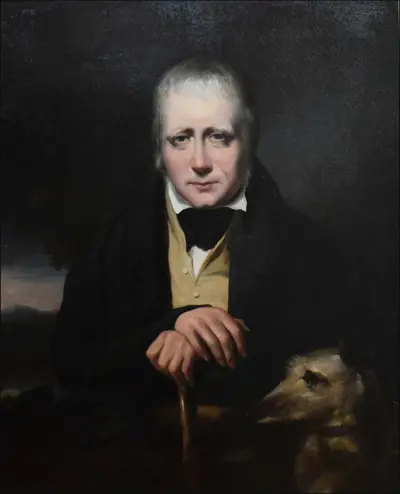
Sir Walter Scott, 1st Baronet FRSE FSA Scot was a Scottish historical novelist, poet, playwright, and historian. Many of his works remain classics of both English-language literature and Scottish literature. Famous titles include The Lady of the Lake (narrative poem) and the novels Waverley, Old Mortality (or The Tale of Old Mortality), Rob Roy, The Heart of Mid-Lothian, The Bride of Lammermoor, and Ivanhoe.
