James Fowler Simmons Quotes
For fifteen or twenty years, the militia trainings have been mostly a farce, nothing but an exhibition of rags, caps, and broomsticks. And with the exception of a few ... volunteer companies, the militia are not to be relied on.
James Fowler Simmons, 1795-1864, U. S. Senator (Whig & Republican, RI), Address, Rhode Island constitutional convention, 1842
Sourced by: Eigen's Political and Historical Quotations

This quotation is very controversial among historians. Beverly was in a sense the first American historian, although he had no formal training. His extolling the military and sharpshooting virtues of his fellows may or may not have been an exaggeration both as to their skill with firearms and their ability as soldiers. There is much evidence that only a minority of the people of Virginia possessed firearms at the time yet Beverly’s image is the one that has come down to us in the romanticized view of early America. Even fellow Virginian, George Washington {613056} complained that his Virginia civilians made poor soldiers compared with “regulars” who had been trained to shoot, and when Virginia militia reported for duty less than one quarter had firearms which were very expensive and not very accurate at the time.

Even today many Americans believe the myth that the American colonial citizen was a skilled marksman who existing skill and familiarity with guns carried the day in the American Revolution. However, even General Washington had to dispel the myth. It was bad politics for members of Congress and other public officials to criticize the local citizenry militias regardless of how inept they were. Less than one fourth of the militia even owned guns and most were unfamiliar with how to use them. Perhaps one of Washington’s greatest military accomplishment was his choosing Van Stuben and other European officers who did such a good job of training a regular army. See {613015}, {613016}, {613022}, {613027}, {621987}, {621988}, {613030}, {613033}, & {613056}.


More than a decade before Hamilton wrote this, a Maryland commission used the phrase “well regulated militia” earlier. (See {588394}.) It would be less than 2 years before the phrase “well regulated militia” would be added into the Constitution in the 2nd Amendment of the Bill of Rights—September 25, 1789. The Maryland resolution was the last of several passed at a meeting by which Maryland endorsed resistance to the British before the actual Revolution. So these resolations would have been widely distributed throughout the colonies and known by the leaders. Whether the drafters of the 2nd Amendment got the phrase from Hamilton’s Federalist 29 or from the Maryland Resolutions is not known but Hamilton’s was much more current. Did he get the phrase from Maryland? Did Congress get it from him? Did Maryland originate the phrase or was there an earlier use that influenced the Maryland drafters? At this point no one is sure, but the phrase is critical to the meaning of the 2nd Amendment because the Supreme Court has repeatedly held that the Second Amandment does not apply to individuals but only to the State’s right to bear arms within the “well regulated militia” and not as individual citizens. The right is that of the State government and that is why a state can control guns including banning them if they choose. So an individual in America does not have the constitutional right to bear arms. He may have a state constitutional right but in other states he may not use a gun in certain places and may not possess certain types of guns like hand guns which are illegal in New York, Washington DC and some other places.

For most of the history of the United States – especially in the governments of our Founding Fathers, there was an extreme antithesis to defense spending and military preparedness a fact that conservatives who look to the Founding Fathers as models and legal precedents for everything that we do today generally do not realize as they lobby for defense spending. The change really took place after Pearl Harbor and WWII where America was totally unprepared for war.

While the militia had very few arms, Van Rensselaer had no military training and commanded a critical army because of his political connections—common at the time. After he botched the Battle of Queenston Heights he returned to politics but his military failure dogged him for the rest of his career. The quotation is yet another that illustrated the myth of all Americans armed and ready to fight for the nation. There was no gun culture then, and guns were expensive and a minority of Americans owned them. In this case less than 20 percent of the American militia owned a gun. And Congress would just not at the time spend the money for weapons.


Washington was not a fan of the militia. It was however preferred by much of Congress who favored local institutions rather than national ones. Competence gave way to politics then as often it does in modern times. See {613015}, {613016}, {613022}, {613027}, {621987}, {621988}, {613030}, {613033}, & {613056}.
At the time most states required all members of the State Militia to “Muster: once a year, Theoretically it was practice for an emergency and there would be training. Each man would bring his arms and these could be checked for serviceability. In reality these were wild drinking parties with local prostitutes very actively involved. With the alcohol, drunken brawls broke out and there was no semblance of military discipline.


This is yet another quotation demonstrating that the image of early America as a gun culture where most men were armed, skilled with those arms, and ready to come to the defense of the country. It turns out that none of the three corresponded to any historical reality for most Americans.

Even in a relatively frontier state like Indiana at the time, there was little enthusiasm for a militia. See {613320}.

Governor Noble himself was a Colonel in the Indiana Militia. Even in a relatively frontier state like Indiana at the time, there was little enthusiasm for a militia. See {613320}.

She was the 5th female member of the House and its first Jewish member. She was the first woman on the House Military Affairs Committee, and was one of the few Republicans who advocated spending for military preparedness. At the time of her service, many Republicans were strict isolationists.


The lack of military preparedness of the United States for the First World War by then was evident and a major subject of political discussion. Mitchel was a “hawk” for his day. He was defeated the next year and joined the military flying service but died in 1918 when he forgot to fasten his seat belt in the airplane and fell from the plane to his death.

See {637854} for a quote on the soundness of our military planning.


Gates had been assigned to take over command of the Southern Department which was a total mess with no provisions or money. He took over from General Lincoln {49731} who had failed for lack of resources and support and then Gates’s career was almost destroyed by the same problem.
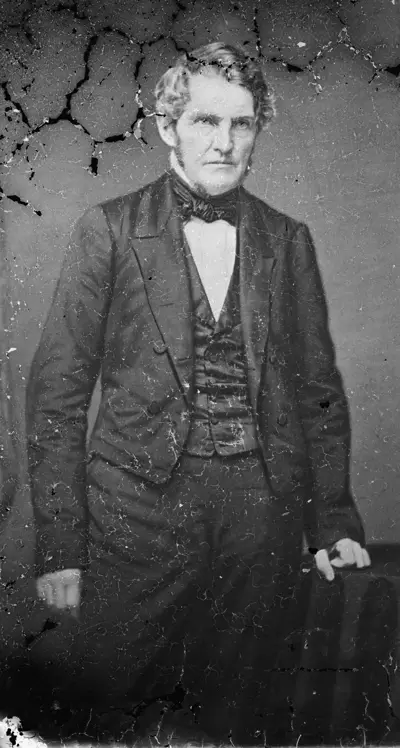
James Fowler Simmons was a businessman and politician from Rhode Island who twice served as a United States Senator, first as a Whig and then as a Republican.
