Noah Noble Quotes
The militia system, … has no hold upon the affections of our citizens.
Governor Noble himself was a Colonel in the Indiana Militia. Even in a relatively frontier state like Indiana at the time, there was little enthusiasm for a militia. See {613320}.
Noah Noble, 1794–1844, Governor of Indiana, Quoted in Michael A. Bellesiles, Arming America: The Origin of Our National Gun Culture, 2000
Sourced by: Eigen's Political and Historical Quotations

Even in a relatively frontier state like Indiana at the time, there was little enthusiasm for a militia. See {613320}.


This was the inception of the Civil War draft.


Just 7 months earlier the King had made a direct appeal to the people for enlistment in the military—See {587166}. The response was very good, but the First World War developed in such a way that huge manpower resources were needed and the King had to reluctantly assent to a military draft.

More than a decade before Hamilton wrote this, a Maryland commission used the phrase “well regulated militia” earlier. (See {588394}.) It would be less than 2 years before the phrase “well regulated militia” would be added into the Constitution in the 2nd Amendment of the Bill of Rights—September 25, 1789. The Maryland resolution was the last of several passed at a meeting by which Maryland endorsed resistance to the British before the actual Revolution. So these resolations would have been widely distributed throughout the colonies and known by the leaders. Whether the drafters of the 2nd Amendment got the phrase from Hamilton’s Federalist 29 or from the Maryland Resolutions is not known but Hamilton’s was much more current. Did he get the phrase from Maryland? Did Congress get it from him? Did Maryland originate the phrase or was there an earlier use that influenced the Maryland drafters? At this point no one is sure, but the phrase is critical to the meaning of the 2nd Amendment because the Supreme Court has repeatedly held that the Second Amandment does not apply to individuals but only to the State’s right to bear arms within the “well regulated militia” and not as individual citizens. The right is that of the State government and that is why a state can control guns including banning them if they choose. So an individual in America does not have the constitutional right to bear arms. He may have a state constitutional right but in other states he may not use a gun in certain places and may not possess certain types of guns like hand guns which are illegal in New York, Washington DC and some other places.

The founder was Charles E. Coughlin, 1891-1979, a demagogic Catholic Priest who drafted the principles and invited others to join him. Hundreds of thousands did in this organization which began in idealism, and ended in scandal and hate mongering, so much so that Father Coughlin was ordered off the radio and out of politics by the Catholic Church. The National Union in 1936 had morphed into the Union Party which ran Presidential candidates in the 1936 election. In this principle there were two purposes: First to have the wealthy sacrifice something in time of war. Historically wealth could keep a man from the draft if he so wanted. Second, when the company went to war the argument went it was the rich who could profit who had more political influence and could make the war. This way, they would pay a high price and might oppose war. Many of Coughlin’s followers were pro-German and wanted to keep the country out of the European war.


Many of the young men who were given this form to fill out, had never been in Japan and some did not even know there was an emperor there. Nonetheless the Japanese American divisions of enlistees were the most effective and most decorated fighting units for America while their parents who had not been born in America were still imprisoned in the internment camps. See {624010}.


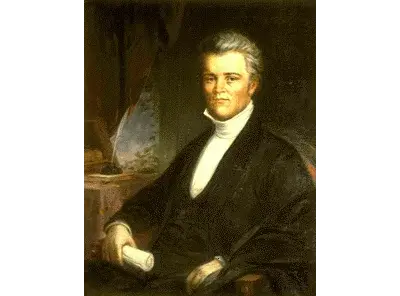
Noah Noble was the fifth Governor of the U.S. state of Indiana from 1831 to 1837. His two terms focused largely on internal improvements, culminating in the passage of the Mammoth Internal Improvement Act, which was viewed at the time as his crowning achievement. His taxing recommendations to pay for the improvements were not fully enacted, and the project ultimately led the state to negotiate a partial bankruptcy only a few years later. The debacle led to a gradual collapse of the state Whig party, which never regained control of the government, and led to a period of Democratic control that lasted until the middle of the American Civil War. After his term as governor he was appointed to the Board of Internal Improvement where he unsuccessfully advocated a reorganization of the projects in an attempt to gain some benefit from them.
