Mike DeWine Quotes
Even beyond policy considerations, Romneycare was a horrible model to suggest for the federal government because the Constitution does not give Congress the power to impose an individual insurance mandate.
DeWine, Mike. "Why I Switched My Support to Santorum." The Columbus Dispatch, 19 Feb. 2012, p. G3.


President John Adams Alien and Sedition Acts were amongst the worst laws ever passed in America. It totally violated the First Amendment but at the time the Supreme Court had not ruled on the laws which prohibited criticizing the government. Ironically, it was Adams’s son, John Quincy Adams who finally led the repeal effort.
This is a classic type of fallacious political logic. The author claims that there are no powers in the constitution to make laws in a number of important areas of our society. What is true, is that there is no explicitly and uniquely specified statements in the Constitution regarding the areas he specified (and some he didn’t like education). However the power to make laws in these areas comes from the “Commerce Clause” where the Federal Government was given the power to regulate Interstate Commerce. And that is what the Federal Government does make laws about. Food that is sold in the state where it is grown is regulated by the states. But interstate agriculture is. Medicines and weapons are also sold and transported in interstate commerce. Even housing is in part covered as financing and mortgages, building materials, working conditions of the building companies are part of Interstate Commerce. A succession of Congresses have recognized this and so has every Supreme Court in our history. McManus however believes that all these legislators and judges have been wrong and worse, part of a conspiracy to subvert the Constitution. See {630683} for his tendency to see conspiracies in politics.


In 1832 the Supreme Court held that the state of Georgia could not remove Creek and Cherokee Indians from lands that had been guaranteed to them by a federal treaty. The president disagreed with the court, then headed by John Marshall:. Marshall could not do so without the executive. The Indians were illegally removed to Western lands.
Soon after Jackson's reelection, delegates from South Carolina, led by John C. Calhoun, moved quickly to declare "null, void, and no law" the Tariff Act of 1832. The president's reaction to the Ordinance of Nullification was swift.

On June 12, 1789 a Senate committee proposed a federal court system for the nation. Maclay described it as:

The major issue was whether Congress and the Federal Government could make laws and regulate the communities of people who had settled in the new territories. The argument that Young made was that unless a power was specifically enumerated in the Constitution as being granted to the Federal Government it was not. Most Constitutional scholars believe that there were powers implied by the enumerated powers such as the right for the Federal Government to regulate child labor or the safety of nuclear power plants which of course were never mentioned in the Constitution. At the same time anti Mormon sentiment led many to extend Federal Regulation to Mormons that had not been extended to other people. Plural marriage was one of those major value issues. The Mormons were very innovative in setting up institutions like buying cooperatives and systems for medical care and welfare, and many of these threatened the then established economic principles of many men of power and wealth. See {614881} for Brigham Young’s similar view.


George W. Bush. See {618119} for the rejoinder to the defense.
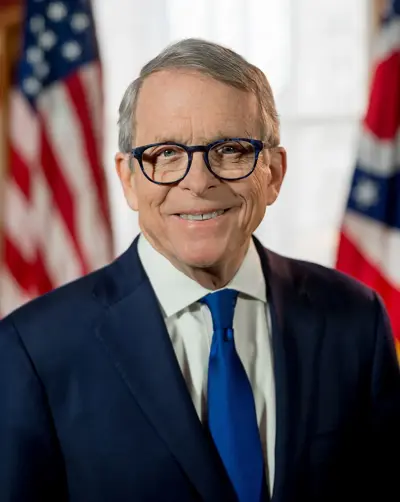
Richard Michael DeWine is an American politician and attorney serving as the 70th governor of Ohio since 2019. A member of the Republican Party, DeWine previously served as Ohio Attorney General from 2011 to 2019, United States Senator from 1995 to 2007, and Lieutenant Governor of Ohio under George Voinovich from 1991 until 1994.
