Winston Churchill Quotes
Don't talk to me about naval tradition. It's nothing but rum, sodomy, and the lash.
Winston Churchill, 1874-1965, British Prime Minister (Conservative), Quoted in Peter Gretton, Former Naval Person
Sourced by: Eigen's Political and Historical Quotations


Named after penal reformer Johne Howard, 1726-1790. Howard Associations have since been organized in many countries.

The statement originates from the English navy where one of the worst forms of punishment was to be whipped with a “Cat of Nine Tails”, a vicious 9 thong whip. On board ship, it was carried in a bag by a petty officer and removed for punishment. Hence the saying.


America’s oldest foreign policy problem has been freedom of the seas for American shipping. Since the end of WWII, the U. S. however performed this function—and pays for it—for the entire world with some minor exceptions.

It is hard for us to envision that sophisticated and intelligent men like Sherman would actually see Communism as a danger of defeating capitalism. Our intelligence was poor and often exaggerated to justify military buildups and much of the leadership made statements like this and then many began to believe their own propaganda. Ironically, those who knew communism the best were more aware and realistic of the fatal flaws in not only communism in general but in the particular Soviet repressive version of communism. It would take almost 50 years, but the Soviet Union collapsed revealing its weaknesses for all to see.

Rush ran the hospitals for the Revolutionary Army and talked to many officers and enlisted men, and also observed much of the British military practices. These suggestions were discussed but never passed as regulations. They are fascinating insights into the problems of the general officers of the time who were generally selected for their socioeconomic status rather than other qualifications. Note the drunkenness limitation for a commanding general was proposed to be limited to only 1 allowed bout of drunkenness every 24 hours. It was, he thought, totally unrealistic to require generals to be always sober when on duty. With the mediocre quality of senior officers, Washington had to depend on foreigners like Lafayette, Von Steuben and others. And Generals who were leading attacks out in front of their men like Benedict Arnold immediately became heroes and one of the reasons he ended up as a traitor was that he thought that he was badly treated relative to the “society” Generals who would not accept him and denigrated his exploits when they themselves had never been close to a battle front.

This historical quotation is surprising to us over a century later. We are surprised at the very large revenue from the then relatively low tax rates on alcohol and tobacco and many people who did not pay their taxes at the time. Also, the incredibly small appropriation for the military. WWI was only 4 years away. Generally, until the Second World War, the Democratic party did not advocate large military expenditures and the Republicans were more isolationist and opposed almost all defense spending. After WWII, the Republican Party flip flopped and became the champion of military readiness and defense spending.


June 1941 was the date that Nazi Germany invaded Russia.

See {615006} for but one example of terrible military money and procurement management.

He was objecting to the current crop of senior military officer who have little experience in fighting and much in academic, strategic and technical training. Many however see him as a dinosaur who does not realized the complex nature of the modern military missions. In general, we have won almost all of our fighting battles but often failed in our maintaining civil society, occupation, nation building, military procurement, preventing sexual assault of our own troops by our own soldiers, assuring mental health of our soldiers. Hackworth, detractors argue, wants to change what already works and ignore what does not.


FDR, Eleanor and lost liberals of the time were advocates of a strong military, and unlike after the 2nd Word War, most of the Republicans were conservative isolationists who were opposed to spending much public money for the armed services or weapons.

The sloop Margaretta was escorting 2 small merchant vessels came into the port of Machias, Massachusetts to purchase some lumber and firewood. However the commanding officer of Margaretta did not like the terms of the negotiations and threatened the town. An aroused and angry group of patriots then boarded and attacked the two merchant ships. The commander of Margaretta then maneuvered out of the port having lost the two small ships. But the Patriots were angry with the commander of the sloop and being excellent seamen who knew the local waters, used one of the merchant ships and a small local vessel to chase down the Naval sloop. They then boarded and captured Margaretta and fatally wounded the commander, James Moore. While Lexington was the first land victory for the patriots, this was the first sea victory and the Margaretta was the first British warship that was captured by the Patriots.

One of the interesting things about Roosevelt is that he thoroughly enjoyed both the politics and the administrative parts of his different positions.

Most Americans do not realize that our naval forces were disbanded after the Revolution and even the Constitution did not require a navy. We had some Federal revenue cutters to interdict smugglers but no warships and no permanent sailors or officers. The Barbary Pirates had an incredible extortion racket going in the Mediterranean. If nations would pay them an annual sum each year, they would not attack and seize merchant ships of that country and sell the ships and goods while holding the sailors for ransom. See {640850},86703,{640846} & {640848}
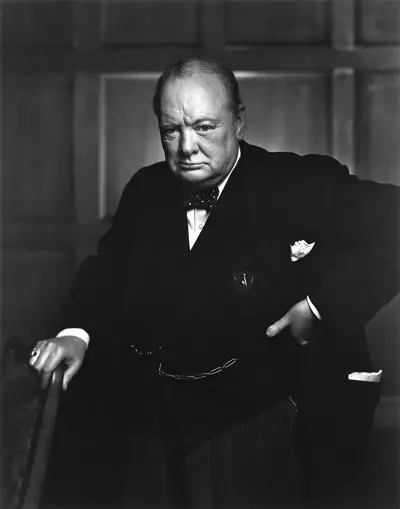
Sir Winston Leonard Spencer Churchill, KG, OM, CH, TD, DL, FRS, RA was the Prime Minister of the United Kingdom from 1940 to 1945, during the Second World War, and again from 1951 to 1955. Apart from two years between 1922 and 1924, Churchill was a Member of Parliament (MP) from 1900 to 1964 and represented a total of five constituencies. Ideologically an economic liberal and imperialist, he was for most of his career a member of the Conservative Party, as leader from 1940 to 1955. He was a member of the Liberal Party from 1904 to 1924. Churchill was also well known for his military career and as a historian, painter and writer, and among his many awards was the Nobel Prize in Literature.
