Augustus Quotes
By the will of the people of the Romans, that the Jews shall use their own customs in accordance with their ancestral law …. anyone is detected stealing their sacred books or their sacred monies, either from a synagogue or from a [Jewish] mans' apartment, he shall be considered sacrilegious and his property shall be brought into the public treasury of the Romans.
Augustus, 63 BC-14, First Roman Emperor, Edict, 1 BC
Sourced by: Eigen's Political and Historical Quotations

The Roman Empire of 70 million people contained at the time 7 million Jews—the vast majority of the world’s Jews.


Constantine the Great. Roman Emperors saw Christians as their most dangerous foes. However, Constantine, with this edict, enabled Christianity to thrive and grow legally in the Western world. Later Constantine himself converted to Christianity. This edict ceased the vicious Roman persecution that Christians had endured.


The Torah consists of the first 5 books of the Old Testament. For Orthodox Jews, the Torah is central and fundamental to their belief structure. In most democracies, a statement such as this might be made by a religions fundamentalist, but is unexpected when uttered by a high government official. However, in Israel there are several small religious political parties which oftem become very powerful when the major policies are of approximate equal strength. To entice them to join their coalition, the major parties give the religious parties cabinet positions. In this particular instance, Neeman’s party in the governing coalition could cause the government to fall, So a Justice Minister of a Modern Democracy can actually repudiate the laws and supreme court whenever they are not in harmony with “the word of God” and not lose his post or even be repudiated. There is probably no other country in the world where the Minister of Justice has repudiated the law of the land and the nation’s highest court.

Jefferson drafted the law which became the basis for the First Amendment to the Constitution. Others wanted change in some of Jefferson’s language to be Christian Centric but the delegates rejected that idea. See {623696}. The separation of church and state was not to be total. The state and the law was required to protect religion—all religions including those thought to be heretical.

The Kotel -- or the "Western Wall" or the "Wailing Wall" as most outside of Israel call it -- is the Holiest of Jewish places where many Jews gather and pray. But the Ultra-Orthodox Rabbis who were charged by the Israeli Government to manage the Wailing Wall and vicinity had refused to allow women to pray at the wall. After much litigation, the Israeli Supreme Court ruled that women had a right to pray there or anywhere else. After much foot-dragging, a small out of the way area at the wall was designated for women, but many Jews wanted to pray as a family which also offended those Rabbis in control of the area, After more Supreme Court Litigation the Government was ordered to establish an area at the Wall that was open to all. The Israeli Government Ministerial Committee for Holy Places was charged with implementing the Supreme Court rulings. However, Regev--who had ambitions of running for Prime Minister, was a conservative whose political base included the Ultra-Orthodox. When they objected to the Supreme Court Ruling, she resigned from the Commission she chaired rather than implement the law of the land. Her official view on the dire consequences of women (or mixed gender) praying at the Wall brought her the support of her base and the strong opposition of most Israeli women and many men as well.

Porush was one of the Haradi--ultra-orthodox Jews. In the land of the Jewish people, he argued against religious freedom for Jews unless they were Orthodox Jews, while ironically, the majority of Jews in the world and even in Israel followed the Conservative or Reform branches of Judaism or were secular. At the time the Orthodox Jewish movement was the only one that was recognized officially by the government. Porush and some of the more fanatical Haradi were determined to keep the Conservative and Reform Jewish branches unrecognized and unsupported by the government. (Israel does not have separation of church and state and economically supports the Orthodox Jewish establishment but not the other majority branches of Judaism.) The "Women of the Wall" is one of the major groups in Israel advocating equal government treatment for all citizens o0f Israel. Orthodox Judaism, like many other orthodox religions are very sexist and women were actually banned from praying at the holiest of Jewish places, the Western or Wailing Wall. Women of the Wall had won a major decision of the Israeli Supreme court that women could not be denied the right to pray at the Wall. The orthodox rabbis who the government allowed to control access to the Wall, set aside a small area for women at the "Dung Gate" where the garbage was carried out. Women of the Wall were back in court and this prompted Porush's outburst. He was cebsured by the Ethics Committee of the Israeli Knesset (Parliament).

Spinoza’s ideas were considered so radical and dangerous that he was the only man in history who was excommunicated by the Catholics, the Jews and the Muslims. This was his observation after his first excommunications -- by his Jewish Congregation in Amsterdam.

Constantine the Great. This is one of Constantine’s major defenses of his decision to adopt Christianity. Scholars today still argue as to what part practical politics played in Constantine’s conversion and what part was his personal religious conversion.


At first this clause appears to be very enlightened and establishing freedom of conscience. This clause allowed Catholics to practice freely whereas in other colonies they could not. However, as one reads on, it becomes clear that the “tolerance” is limited to Christians only. Then if one examines the exception within the parentheses and refer to the rest of the act—see {611994}—, one finds that even Christians who have certain theological beliefs are to be put to death—those for example who deny the holiness of the Trinity such as Unitarians who were a major group in the New England Colonies. It was a significant step at the time however to protect Roman Catholics.

This document was Drafted by members of America’s leading faiths and signed by the Presidents, two Supreme Court Chief Justices, and nearly 200 other leading citizens.

In that era the favoritism of the government—especially state and local government—in favor of the of the Protestant Christians. Politicians started challenging the clear unconstitutional favoritism. The reformers were Republicans often referred to by the Democrats as “Godless Republicans”. A century later the Republicans would oppose strict separation of church and state with the Southerners and Fundamentalist Christians in their party and the Democrats fighting to maintain strict separation of church and state.
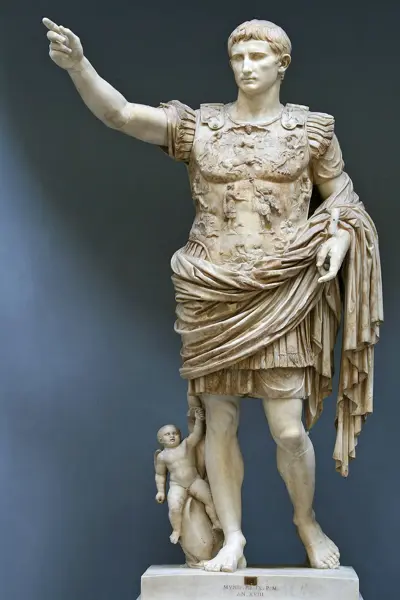
Caesar Augustus was the first Roman emperor, reigning from 27 BC until his death in AD 14. His status as the founder of the Roman Principate (the first phase of the Roman Empire) has consolidated an enduring legacy as one of the most effective and controversial leaders in human history. The reign of Augustus initiated an era of relative peace known as the Pax Romana. The Roman world was largely free from large-scale conflict for more than two centuries, despite continuous wars of imperial expansion on the Empire's frontiers and the year-long civil war known as the "Year of the Four Emperors" over the imperial succession.
