Ulysses S. Grant Quotes
By arming the Negro we have added a powerful ally. They will make good soldiers.
Ulysses S. Grant, 1822-1885, 18th President of the United States (Republican, OH), Quoted on PBS The Civil War, September 23, 1990
Sourced by: Eigen's Political and Historical Quotations


There was extensive Northern opposition to the idea of Blacks fighting in the Civil War, even from some abolitionists who saw the war as a vehicle to end slavery. A few were concerned that Blacks would be executed by the South if they were captured, and hence would be exposed to unreasonable risk. Others, believed there was sufficient manpower and Blacks fighting would make the South fight harder. Many didn’t believe that Blacks were competent to be soldiers, and others didn’t want Blacks to develop the skills that would later enable them to compete for jobs with whites. Before Albion raising the 54th there were a few Negroes who were in Union uniform, but the concept of a Negro regiment was a much more visible, and controversial concept.


The U. S. Navy had Black sailors even before the Civil War. Blacks had shipped out on Northern merchant vessels and whaling ships starting in colonial times. Many Blacks had nautical experience and were welcomed by the Northern Navy and treated very well. The Union Army in contrast was much more ambivalent about Blacks serving. Ironically the Navy was disbanded to save money and when it was reconstituted it was on a racially segregated basis completely foreign to American Naval history. It was the last of the American armed services to integrate and its officer corps has not desecrated as much as the other services.

In the middle of WWII where Black soldiers were fighting and dying on the war front, there were fears of racists that the Blacks would return and demand full equality and an end to segregation. There were threats in the South of armed attacks against any returning serviceman who would push for desegregation.

He was a deeply religious Christian which is one of the reasons that he was appointed to head the Freemen’s Bureau to integrate the emancipated slaves into society. Howard University was named for him, and he served as its First President. For more about the Bureau. See {629185}.and {629187}.

The Nixon "Southern Strategy" was that if the Republican Party made extensive efforts to appeal to minorities, given the previous decades of support of white supremacy, they would only be successful with a few, whereas if the Party went in the other direction and supported the Whites fighting against the Democratic initiated, racist hated, Civil Rights Act, they would get almost all the racist Southern Democrats, which were most white males and many white females. This racist policy enabled the Republicans to gain control of the Federal Government more often than not whereas before, it was very unusual.


Lincoln later changed his mind about Colonization when some Black leaders pointed out that the Blacks had built a large part of America and also survived slavery, it they were given fair opportunity, there was no reason that they would not be able to compete and thrive.


Benjamin was the Confederacy’s strongest proponent for use of Negro troops in exchange for a promise of freedom. Ironically, the racial prejudice of the Southern soldier may well have doomed the South’s last chance for independence. Lee, although he personally favored such a course of action, could not get a general sentiment from the army as a whole.


Just a month earlier Washington had issued a contradictory order. See {614221}. The Continental Congress, under pressure from the Southerners, compromised.

Despite the critical need of the war, racism was so extensive in the WWII military that Blacks were relegated to menial duty of cooking, truck driving and construction but were actually not allowed to fight at the beginning despite the fact that many had volunteered. Many whites—especially the southerners—were convinced that Negroes could not fight, that they lacked the courage and commitment. The need for troops in the Pacific theater was so great that in the invasion of Saipan that was so difficult, Black troops were committed to the fight and performed brilliantly. The Commandant of the Marine Corps, General Vandergrift was not only the first Marine 4 star general who was on active duty, but he personally was a recipient of the Medal of Honor. When he spoke, all marines and many others in the service listened. This was the break-though. Negroes in combat was no longer some kind of social experiment for most Marines except the most vitriolic rascists.

Lorenzo Thomas Adjutant General U.S. Army He was a sergeant with a teaching background when he wrote this letter. He volunteered for the new duty and was commissioned an officer in the 9th Louisiana Volunteer Infantry—one of the Negro Divisions. A few months later he was killed in action.

This part of Taft’s Inaugural Address shocked the South and much of the North. But these were the days when the Republican Party was the liberal party on racial issues and the Democratic Party housed most racists and bigots. On this, the parties would flip flop after the Democrats passed the Civil Rights and Voting Rights Bill. Both Taft and TR were racial liberals and the South coalesced around Woodrow Wilson, an intellectual but an inveterate racist.

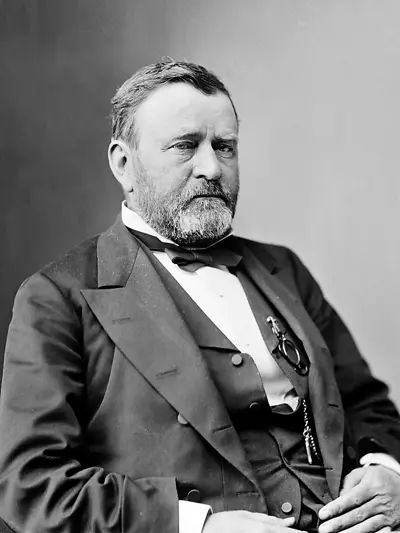
Ulysses S. Grant was an American military leader who served as the 18th president of the United States from 1869 to 1877. As president, Grant was an effective civil rights executive who created the Justice Department and worked with the Radical Republicans during Reconstruction to protect African Americans. As Commanding General, he led the Union Army to victory in the American Civil War in 1865 and thereafter briefly served as Secretary of War.
