John Albion Andrew Quotes
Every race has fought for its own progress.
There was extensive Northern opposition to the idea of Blacks fighting in the Civil War, even from some abolitionists who saw the war as a vehicle to end slavery. A few were concerned that Blacks would be executed by the South if they were captured, and hence would be exposed to unreasonable risk. Others, believed there was sufficient manpower and Blacks fighting would make the South fight harder. Many didn’t believe that Blacks were competent to be soldiers, and others didn’t want Blacks to develop the skills that would later enable them to compete for jobs with whites. Before Albion raising the 54th there were a few Negroes who were in Union uniform, but the concept of a Negro regiment was a much more visible, and controversial concept.
John Albion Andrew, 1818-1867, Governor of Massachusetts, Statement justifying the raising of a Black regiment [54th Massachusetts] to fight against the South in the Civil War.
Sourced by: Eigen's Political and Historical Quotations


Lieber was assigned by President Lincoln to study the then international laws of war and prepare a manual for the guidance of union troops in the Civil War. Lincoln then issued the document as a general order. This statement was critical in inhibiting the South from making good on their threat to enslave any Black Union Soldier Captured and to execute any Union Black soldier who was a runaway slave from the South. Lincoln threatened to retaliate and also to hold senior Confederate officers accountable for following these rules. General Sherman and other Union Senior Officers executed a few Confederate soldiers who violated rules of the order and the “illegal” practices stopped, and with few exceptions the senior officers of both sides followed Lieber’s rules. These rules, with few modifications, governed U. S. military policies and rules through the Second World War.

Smith, an extreme racist, was so rabid that MacGregor was supporting the Civil Rights Bill, he followed him off the House floor to make this statement. MacGregor jokingly told Smith that he was wrong. He had 17 Negroes in his District.

He would not allow himself to be buried in a cemetery that would not allow Blacks. He was laid to rest in Shreiner's Cemetery, one of the very few racially integrated cemeteries at the time.

In the 1930s African Americans who traveled were subject to countless humiliations whenever the sought hotels, rooming houses, restaurants and other accommodations. Gas stations would not allow them to use bathrooms and they were reduced to using open fields. Traveling and vacationing was, for Blacks, humiliating. Wikipedia: “Green reviewed hotels and restaurants that did business with African Americans during the time of Jim Crow laws and racial segregation in the United States. He printed 15,000 copies each year. In the 1930s, Green began his work by compiling data on stores in the New York area that accepted black travelers, and published his first guide in 1936. Similar guides had been published for Jewish travelers, who sometimes faced discrimination. Green's guide was so popular that he immediately began to expand its coverage the next year to other US destinations, adding hotel and restaurants as well.”


The Secretary of State told the President he was resigning to save the administration possible embarrassment over his daughter's planned marriage to a black man:


Despite the critical need of the war, racism was so extensive in the WWII military that Blacks were relegated to menial duty of cooking, truck driving and construction but were actually not allowed to fight at the beginning despite the fact that many had volunteered. Many whites—especially the southerners—were convinced that Negroes could not fight, that they lacked the courage and commitment. The need for troops in the Pacific theater was so great that in the invasion of Saipan that was so difficult, Black troops were committed to the fight and performed brilliantly. The Commandant of the Marine Corps, General Vandergrift was not only the first Marine 4 star general who was on active duty, but he personally was a recipient of the Medal of Honor. When he spoke, all marines and many others in the service listened. This was the break-though. Negroes in combat was no longer some kind of social experiment for most Marines except the most vitriolic rascists.


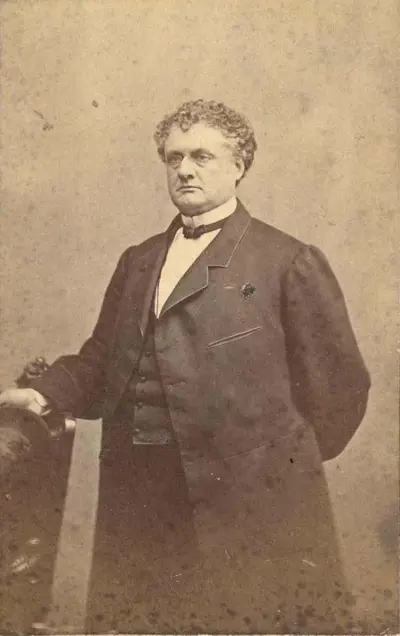
John Albion Andrew was an American lawyer and politician from Massachusetts. He was elected in 1860 as the 25th Governor of Massachusetts, serving between 1861 and 1866, and led the state's contributions to the Union cause during the American Civil War (1861-1865). He was a guiding force behind the creation of some of the first African-American units in the United States Army, including the 54th Massachusetts Infantry.
