Lyndon B. Johnson Quotes
This is the most progressive Administration in the civil rights field in history, and you're going to quit over that? I want the Johnson Administration to practice what it preaches.
The Secretary of State told the President he was resigning to save the administration possible embarrassment over his daughter's planned marriage to a black man:
Lyndon Baines Johnson, 1908-1973, 36th President of the United States (Democrat, TX), Remark to Dean Rusk
Sourced by: Eigen's Political and Historical Quotations


Humphrey was the Mayor of Minneapolis then.


There was extensive Northern opposition to the idea of Blacks fighting in the Civil War, even from some abolitionists who saw the war as a vehicle to end slavery. A few were concerned that Blacks would be executed by the South if they were captured, and hence would be exposed to unreasonable risk. Others, believed there was sufficient manpower and Blacks fighting would make the South fight harder. Many didn’t believe that Blacks were competent to be soldiers, and others didn’t want Blacks to develop the skills that would later enable them to compete for jobs with whites. Before Albion raising the 54th there were a few Negroes who were in Union uniform, but the concept of a Negro regiment was a much more visible, and controversial concept.

He had written this text on a newspaper when he was jailed in Birmingham for violating a court order not to demonstrate. A common tactic of the Southern segregationists was to have local segregationist judges issue injunctions against civil rights demonstrations on the grounds that they would promote violence. These were generally unconstitutional, but King and others were jailed until the legal appeal could even be heard.

This was the first major civil rights speech. He had previously in his political career tread carefully in the civil rights arena. The Southerners had disproportionate control over the Congressional committee chairmanships and they could hold up his entire legislative agenda. JFK’s father was a right wing fascist who supported Hitler earlier and always advised against pushing civil rights.


Before the civil rights act was passed, most labor unions will racist and discriminated against black workers. The United Auto Workers union was an exception and Reuther was a strong advocate of desegregation and equal rights.

He would not allow himself to be buried in a cemetery that would not allow Blacks. He was laid to rest in Shreiner's Cemetery, one of the very few racially integrated cemeteries at the time.

In the 1930s African Americans who traveled were subject to countless humiliations whenever the sought hotels, rooming houses, restaurants and other accommodations. Gas stations would not allow them to use bathrooms and they were reduced to using open fields. Traveling and vacationing was, for Blacks, humiliating. Wikipedia: “Green reviewed hotels and restaurants that did business with African Americans during the time of Jim Crow laws and racial segregation in the United States. He printed 15,000 copies each year. In the 1930s, Green began his work by compiling data on stores in the New York area that accepted black travelers, and published his first guide in 1936. Similar guides had been published for Jewish travelers, who sometimes faced discrimination. Green's guide was so popular that he immediately began to expand its coverage the next year to other US destinations, adding hotel and restaurants as well.”


This was a very courageous speech for the President to give. Senator Hubert Humphrey had proposed civil rights legislation. At the time most of the racial conservative members of Congress were Democrats and not Republicans as they would become after Civil Rights legislation actually passed in 1964. There was little possibility that the civil rights law would pass as the Southern Democrats could filibuster it in the Senate. None the less Truman supported the legislation and the principle of equal rights despite the fact that he was a Southerner and he knew he would lose the support of the conservative wing of his party.
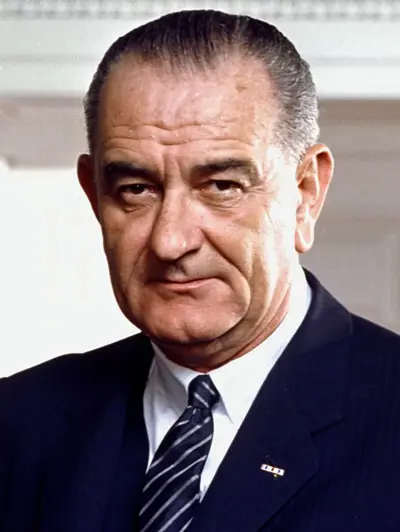
Lyndon Baines Johnson, often referred to by his initials LBJ, was the 36th president of the United States, in office from 1963 to 1969. He served as the 37th vice president from 1961 to 1963 and assumed the presidency following the assassination of President John F. Kennedy. A Democrat from Texas, Johnson was also a United States representative and later majority leader in the United States Senate. Johnson is one of only four people to have served, at various times, in all four federal elected positions.
