Cotton Mather Quotes
Besides the other praying and pious meetings which I have been continually serving in our neighborhood, a little after this period a company of poor Negroes, of their own accord, addressed me, for my countenance to a design which they had, of erecting such a meeting for the welfare of their miserable nation, that were servants among us. I allowed their design and went one evening and prayed and preached with them …
This is the first documentary evidence of Negro slaves in Colonial America organizing a Christian religious service. It was a Puritan service in Massachusetts.
Cotton Mather Diary Entry October, 1693
Sourced by: Eigen's Political and Historical Quotations


Earlier {629154} Smith was much more sympathetic with slavery. His views evolved as you can see by the comparison. He stated that he had a vision and made two prophesies {629156} that indeed came true. The last idea of slave buyouts seemed plausible to many abolitionists initially when they were not really knowledgeable about the economics of slavery. However, once they studied it, it became clear what it would not work even if the Southerners would then be willing to accept Blacks as free laborers which most were not, The two biggest problems were: 1) the international slave trade had been abolished. The only source of new slaves for growth was breeding them. Therefore, having slaves had TWO economic values—the work that they could do and the reproduction of themselves. A critical mass of owned slaves produced an income forever. And for Southerners who were culturally adverse to work (see {629169}), just having cash for their slaves was not enough. They were the servants, the farm labor, and their recreational sex. 2) and most important, the value or the slaves of the South was greater than the economic value of all the land, all the farms, all the buildings, all the factories, and all the inventory of the stores of the South all put together. The Southern slaves were the majority of the wealth of the south. There was no asset that could ever produce enough value to pay for the slaves—even over time. It would be like trying to buy all the shares of all the corporations in America today. There is no asset big enough to raise the money to ever finance it. The idea may have worked in Colonial America or even prior to the outlaw of the international slave trade, but by the time anyone took the idea seriously it was economically no longer feasible.

This was surprising for a man who owned slaves all his life.


The Quakers were in the forefront of not only the abolition of slavery but of the integration of the races.


While this apostolic letter condemned the slave trade, it fell short of clearly implicating the entire practice of slavery. It is clear that the Catholic Church at this time was reluctant to abandon its earlier teaching which approved of “just title” slavery. This distinction approved of “slavery” in circumstances in which the person was deprived of their liberty justly. Specific examples in the past have included slaves captured in war, persons condemned to slavery for a crime, and those who sold themselves into slavery.


The Roman Catholic Church in America had a very difficult problem with slavery. Catholics were themselves a minoirty, hated and distrusted by many Protestants. In most of the country, the distrusr was based on their large immigrant population, but in the South Catholic theology was hated and the Vatican and Pope were particular targets. The Catholic Clergy generally did not want to take sides in the most contentious issue in America since its inception. The Southern Catholic Clergy did not have that option as in the South, anyone who was not a supporter of slavery was an "enemy of the community and subject to all kinds of violence." Some Southern priests were willing to take the personal risk but did not want to put their followers at risk. In a strange consequence, Catholics--especially Irish Catholics--fought on both sides of the Civil War and often against each other. While it was not an exemplary moral behavior for the Church, there were difficult pressures on Catholic leaders. Further, most of the lowest and most difficult, undesirable jobs were filled by Catholics and most Catholic laymen so and end to slavery as the start of pitting the Catholics against the Blacks. So there was not a groundswell for abolition in most Catholic parishes even in the North.

Pickering referred to Jefferson as the “Negro President” because he believed his presidential power rested on the shoulders of slavery.

The organization was one of the first organized to agitate against the slave trade. He had organized many of the intellectual leaders of France to join in this effort.
The king was making his judgment that the English whites did not have the “gut” to kill the number of people and perpetuate the other cruelties to forcibly convert Black Africans to Christianity, and even if they did, it would be inconsistent with the moral tenets of the religion. He was not familiar with the Reformation persecutions of previous generations, nor did he anticipate the effect of colonialism by which large parts of Africa were culturally and religiously converted.

We beseech His Majesty to interest himself in ameliorating the condition of negroes in the colonies.
This Cahier was the consensus of the Clergy of Blois in 1789. There were cahiers of several provinces of France—some by the clergy, some by the nobles. What is fascinating is the emergence of many of the pre-Revolutionary French concepts. The example of the American revolution and its principles was known throughout the educated classes of France.
This is the Holy Book of the Afro Athlican Constructive Church. This Afro-centric religion, founded in the 1920s in America considered Blacks the “sons and daughters of Ethiopia,” recognized Rogers as “Shepard” and Marcus Garvey as "Prophet and Apostle". The religion and The Holy Piby was so threatening to established Negro religions of the time that it was banned in Jamaica and other parts of the Caribbean. It is considered one of the fundamental religious sources for Rastafarians. It is often referred to as “The Black Man’s Bible.” It was translated from a “lost Amharic text” which tells of the lost tribe of Israel migrating to Ethiopia.
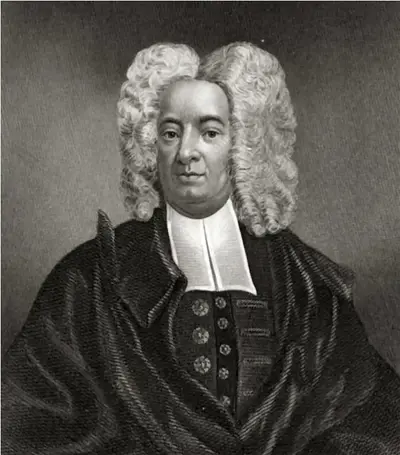
Cotton Mather /ˈmæðər/ FRS was a New England Puritan minister, prolific author, and pamphleteer. One of the most important intellectual figures in English-speaking colonial America, Mather is remembered today chiefly for his Magnalia Christi Americana (1702) and other works of history, for his scientific contributions to plant hybridization and to the promotion of inoculation as a means of preventing smallpox and other infectious diseases, and for his involvement in the events surrounding the Salem witch trials of 1692–3. He also promoted the new Newtonian science in America and sent many scientific reports to the Royal Society of London, which formally elected him as a fellow in 1723. A controversial figure in his own day, he sought unsuccessfully the presidency of Harvard College, which had been held by his father Increase, another important Puritan intellectual.
