George S. Patton Quotes
As a result of this war, I’ve had… changes of heart -- I believe in female nurses.
The belief was that women were too fragile to be able to stand up to the pressure of a battlefield situation. All nurses had to be male. However, men were needed to do the fighting and some nurses were assigned to battlefield situations.
George S. Patton, 1885-1945, U.S. Army General, Letter, 1943
Sourced by: Eigen's Political and Historical Quotations

First woman elected to Congress. She voted against the declaration of war in WWI and was the only member of Congress to vote against war in WWII.


Abbot was apparently ignorant of the American women who did fight in the American Revolution, the War of 1812 or the Civil War where there were a few women who fought on both sides some of whom were decorated. Nor did he seem to acknowledge Joan of Arc and other female warriors in world history. But he would be truly shocked by the tens of thousands of “civilized” women who volunteered and served in the American military once they were allowed to do so and the “civilized” men who fought with them as compatriots.


The attorneys told him that the law required citizenship, nothing else. So for the first time, women were enlisted in the Navy and the Marine Corps. Most of Congress was so offended, that they changed the law to add the word “male”. They created the Women’s Army Auxiliary Corps, which allowed women to serve—even in combat, but men did not have to salute them if they were outranked, nor did the WAACs have other military protection.


She is vehemently opposed to allowing women to serve in the armed forces.

She was instrumental in outlawing slavery and two years after this speech she and her daughters appeared in public without the traditional Burka or veils. The conservative fundamentalists were outraged and they deposed her husband and her modern influence ended.

Interestingly, at the time females hade just eclipsed males in attendance at Canadian law schools
Actually, shortly thereafter some women in Egypt were allowed to be judges, but were not allowed to handle serious criminal cases on the grounds that women could not be hard enough to impose heavy punishment like the death penalty.


Stewart a Black, female journalist wrote at a pre Civil War time when most people were little interested in the writings of either Blacks or women.

This famous statement illustrates the tone of the chauvinism that was dominant in Greece’s golden age and was the attitude of most of Western society for over 2000 years thereafter.

He was a major critic of French Quebec Separatism and some elements of French Canadian culture including his perception of sexism. His French Quebec Separatist enemies translated passages of this work into French and (some say deliberately) mistranslated this line to read: Quebec women are sows. The quotation was bandied about Canada in the original version as well as the mistranslation.

Jinnah was a modern Islamist who saw the role of females in a modern context. He, like the Indian Hindu leaders were in a sense products of the West and Western government and education. He would be very surprised that in his Pakistan men can murder their female relatives who they believe have dishonored the family, or that women would not be educated in the Madrassas, or that authorities could sentence a female relative of a man deemed guilty of seduction to be gang raped, but that is what happens in modern Pakistan. Jinnah and many of the early leaders believed that their new government could modernize Islam but the control and influence went the other way. Pakistan became a religiously dominated autocracy rather than the democracy that Jinnah foresaw.

This proverb is a large part of the conceptual basis of the concept of honor killing. It starts with the notion that women are property. However, being animate property women are in the same class as livestock. And if a camel or a donkey get lose and does damage, the owner is responsible. So if a woman does something wrong, it is the father or the husband who is responsible. Since sexual behavior of most kinds is contrary to the Islamic custom and law, any activity in this regard, demonstrates that the father of husband has not been up to his obligations and is therefore dishonored. Therefore, the least he can do, to provide a deterrent to other women is to kill the offending female. Without the concept of property, the entire chain of logic collapses under its own weight.


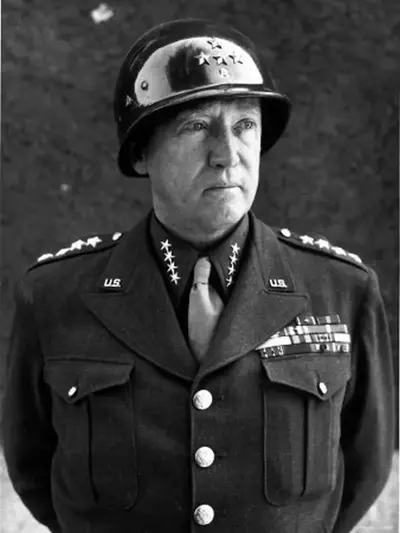
George Smith Patton Jr. was a general in the United States Army who commanded the Seventh United States Army in the Mediterranean theater of World War II, and the Third United States Army in France and Germany after the Allied invasion of Normandy in June 1944.
