William O'Neill Quotes
Andrew Jackson was tempered, arrogant, violent and a ferocious partisan who introduced the spoils system into government.
William O'Neill, Historian “Old Slickery,” New York Times Book Review, November 20, 22005
Sourced by: Eigen's Political and Historical Quotations

Jackson ignored the decision of the Supreme Court and forced at bayonet point the Indians in the South East to leave their land and relocate to Oklahoma in what has been known as “the trail of tears”.

The all white regular Mississippi Delegation was selected in elections where Blacks were barred from voting although Blacks were in the majority in Mississippi. In addition, the regular party was advocating obstructing the Supreme Court school integration decisions and the Civil Rights Act that had just been passed. See {637616}. The insurgent group was selected in integrated elections, contained black and white delegates, and was pledged to support and obey the laws. The President could not make the decision unilaterally, but had a great deal of influence.

Crockett has been a major supporter of Andrew Jackson. However, after Jackson became president Crockett broke with him over some of his new policies and practices. For example, he disapproved of the Indian Removal Bill, which allowed for forced expulsion of the Cherokees and other “civilized tribes” from the southeastern states. Indian removal went along with the unfair treatment of squatters, who were expelled from the public domain and were barred from securing land that they had settled and improved. Jackson supporters castigated Crockett for his “disloyalty” and Crockett was equally critical of them for going along with Jackson like a pack of dogs without daring what his policies were. This quotation was made in this context.

His Indian Removal Policy forced Native American to leave their lands which were theirs by treaties signed by the United States and marched to the poorest land in Oklahoma where they were "resettled". This is often referred to as the "Trail of Tears". What made his actions evern wors was the fact that The Supreme Court had already ruled that such land belinged to the Cherokee Indian Tribe and the government of the United States may not force them from it. Jackson was the only President in Amrican History to defy a Supreme Court order.


At the time Jesse Helms, an arch conservative, was a very powerful senator with a great deal of seniority. As such most senators had to work with him to get many things done. Ironically, despite the fact that he and Helms were on polar opposite political sides, they developed a personal working relationship which was quite cordial.

Chase a Supreme Court justice at the time was a very partisan Federalist. The Senate was controlled by the Democratic Republicans. Randolph, then a member of the House of Representatives, orchestrated the impeachment of Chase because of his extreme partisanship. The Senate in trying the case had to decide for the first time what “high crimes and misdemeanors” the actually means in terms of impeachment. A number of the Democratic Republicans joined the Federalists in taking the view that however undesirable the Supreme Court justice’s partisanship would be, that did not reach the threshold of a “high crime and misdemeanor.” Chase was acquitted. In this sense this impeachment trial was similar to that of President William Clinton almost 200 years later. The behavior was undesirable but did not amount to a high crime and misdemeanor, Clinton was also acquitted.


President Andrew Jackson was the first President who went after them. The mechanism of these men has been bribes, much more common in early and middle America than today where campaign contributions are a legalized way of the wealthy having more influence on the control of the country. The other way was by the control of the money supply, the markets and banking. Jackson would not go along with allowing a small number of very wealthy bankers to control the monetary policy of the country. In modern times, there are a number of left and right wingers who see the private Federal Reserve Bank and its secrecy as an example of what Roosevelt was referring to,


Political Parties go through transformations. In the 1950s the Republican Party had a core that was viciously attacking opponents and calling them Communists and traitors. In the early 21st century, their concern for the National Interest again was dwarfed by the desire to win and hold power, only this time intentional gridlock was added to the slanders. The Democrats have gone through unpatriotic ethical lapses as well. Parties are dynamic and change.

The George W. Bush administration had a strong penchant for loyalty and would not fire Republican officials who had proved incompetent or unethical. In the midst of a disastrous Iraq War, there was a sex scandal in the House of Representatives whereby a Republican member was making homosexual advances to young pages. The House Republican leadership had tried to cover it up rather than protect the pages. Yet no one was fired even after the Congressman resigned and admitted it.

Congress at that time had about a 12 percent public approval rating. Other emergency disaster appropriations had been made in previous years in days or weeks, but the aid for New Jersey, New York and Connecticut had been voted by the Democratic-controlled Senate but not in the Republican controlled House. The Republican House leadership had planned a vote after the Fiscal Cliff vote the previous evening before the end of the Congressional term. Then the speaker cancelled the vote infuriating Christie and many of the members of Congress. His reason was that there was opposition from the Tea Party Conservative wing of his own party who had just been badly beaten on the fiscal cliff legislation, and the Speaker was up for reelection by his own party caucus the following day. If the vote had proceeded, it would have passed with Democratic and some Republican support but with the opposition of the conservative wing some of whom noted that the states seeking the emergency aid had just recently voted for President Obama and they were opposed to more federal spending despite the fact that emergency aid had never before been subjected to such partisan criteria. After much pressure, the Speaker then committed to an up or down vote in the following Congress to the chagrin of some of the Tea Party members. Governor Christie, much admired for his commitment to his state and not politicking was his candid self but he did not even go as far as Republican Congressman Peter King {630995}.
FDR even admitted that very wealthy men and corporations controlled most U. S. governments including the administration of his own political party. Roosevelt did a great deal to improve the situation but by the latter years of the 20th century, private financial entities gained back much of the influence and control. The result was the Meltdown of 2008 and the Great Recession, where another set of regulations and laws (Dodd-Frank) was made law by the Obama Administration. However, the financial corporations still had enormous political influence as a result of unlimited campaign contributions to politicians and unlimited lobbying.

Kerry had just finished a formal presentation, and thought that the microphones he was wearing had all been removed. Some opponents accuse him of knowing that he was overheard by live mikes.

This quotation is hardly believable, even for an ultra extreme, evangelical, Christian, fundamentalist. His paranoia and homophobia went so far as to claim that somehow the only gay Congressman, Jared Polis, was going to bankrupt Christians who did not endorse his homosexuality. How he might do this Klingenschmitt never explained. But then to associate Polis with the Muslim Fundamentalist Terrorist organization ISIS—which executes homosexuals—and claim that Polis would behead Christians in America was over the top. The quotation illustrates the freedom of speech allowed in American political campaigning where the most absurd, libelous, falsehoods are allowed, as well as the fact that an obvious unbalanced person can freely run for office.


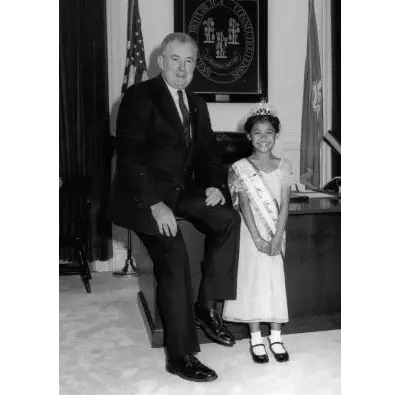
William Atchison O'Neill was an American politician and member of the Democratic Party who served as the 84th Governor of Connecticut from 1980 to 1991. He was the second longest-serving governor in Connecticut history, with 10 years in office.
