Gerald R. Ford Quotes
An impeachable offense is whatever the majority of the House of Representatives considers it to be at a given moment in history.
Ford was then a Congressman and there was a conservative inspired impeachment probe of Supreme Court Justice William O. Douglas.
Gerald R. Ford, 1913–2006, 38th President of the United States (Republican, MI), Speaker of the House, House Debate, April 15, 1970
Sourced by: Eigen's Political and Historical Quotations

The debate was about the unlimited pardon power of the President. Madison argued that the check was the impeachment power. However, Presidents had tended to make large numbers of pardons just before they leave office so the impeachment power works only as a check for the beginning and middle part of their term.


In England, the King was above the law. However, impeachment was a tool that could be used against his favorite ministers. In debating the United State Constitution one of the first questions to be determined was whether impeachment could be a tool used against the President or like, England, only the other government officials. Franklin urged the President be included. See also Mason: {584246}.


The President was advised that if he maintained his policies he would be impeached:

The issue had first arisen during the Watergate Scandal, where there was concern that if the House held impeachment hearings of President Nixon, he might refuse to provide documents or order others in the Executive Branch not to testify. In this hearing, they were discussing the possible impeachment of President George W. Bush.


The Chairmen of the Committees then had tremendous, almost unilateral power. The chairman reached seniority by being elected over and over and had little opposition. At the time they were almost all older Democratic Congressmen from the "Solid South", very conservative and still racists despite the 1964 Civil Rights Act. They were outraged when a Freshmen member of Congress who rarely made a public statement, took on the most powerful members of the House and wanted to reform the Seniority. But Ms. Chisholm was a teacher in her professional life, and by challenging the seniority system and attracting the enmity of most of the Chairmen, the media and the public started to cover the dispute and Chisholm explained to America exactly how the system worked and how undemocratic and racist it was. Her effort put the Seniority System on the public agenda, and reforms evolved over the next decades." She was the first Black woman to be elected to Congress and was the first Black woman to actively campaign for the Presidency

This was one of the best confirmations that Nixon had authorized illegal activity to further his reelection prospects and then orchestrated a cover up of the crimes.


This quotation has much more meaning that similar statements of dozens of other people who claimed Bush should be impeached. The reason is that Fine was a strong conservative wanting to impeach a conservative President and he was the person who drafted the articles of impeachment against President William Clinton which passed the House but Clinton was acquitted by the Senate. So Fine was generally seen as a partisan for Republican Conservatives like Bush and a man who acted strongly against Clinton, and yet he observed in this quotation that Bush’s crimes were more serious. See {583797} for a concurring view on impeachment of Bush.

The convention turned down the constitution and would not ratify it until the Bill of Rights was passed later.

Parliament had developed a formal mechanism of removing officials in extreme circumstances. It was borrowed for the U. S. Constitution. See {584256}.


Two years later with bipartisan support Speaker Joseph Cannon was stripped of his party and the Rules Committee was created.

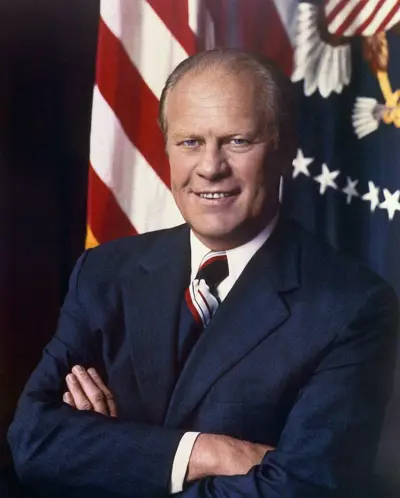
Gerald Rudolph Ford Jr. was an American politician and attorney who served as the 38th president of the United States from 1974 to 1977. A member of the Republican Party, Ford previously served as the 40th vice president of the United States from 1973 to 1974. To date, Ford is the only person to have served as both vice president and president without being elected to either office by the Electoral College.
