William Rehnquist Quotes
A strict constructionist is a judge who favors criminal prosecutors over criminal defendants and civil rights defendants over civil rights plaintiffs.
Two openings appeared on the Supreme Court for Nixon to fill. He heard from many people on recommendations, but he wanted to fill the posts with “strict constructionists.” Rehnquist had written giving him a political operational definition of a strict constructionist. This memo was never released to the public by the White House on the grounds that it was protected by Executive Privilege. However, the definition given had virtually nothing to do with the concept of strict construction but is a definition of a ideological conservative constructing his own meaning to the Constitution. The source for the text came from John Dean, the Counsel to the President, who found this memo in his White House file and revealed it at a question and answer session at the Commonwealth Club of San Francisco, October 10, 2001.
William Rehnquist, 1924-2005, Chief Justice, U. S. Supreme Court, Memorandum to President Nixon
Sourced by: Eigen's Political and Historical Quotations


The New Deal liberal Democrats had complained that the Supreme Court was making national policy and law and not interpreting law. They tried to pack the Supreme Court by adding more justices who would be more sympathetic to the New Deal. (See {587549}.) At the beginning of the 21st century it was the conservative Republicans who were making the same claim that the Supreme Court was making law and not interpreting it. The pattern seems to be when the court votes for your side, they are interpreting the law. When they vote for the other side, they are activist—making law improperly.


This quotation is particularly important because it summarizes one of two opposite schools or thought regarding judicial interpretation of the Constitution that politicians have been arguing about since the Supreme Court first sat. The other is Original Intent where only the original intentions of the writers and ratifiers of the Constitution should be considered—assuming that it can be determined.


Referring to the Brown v. Board of Education, the Topeka, KS, Supreme Court school desegregation decision:

Cummings was arguing against a Constitutional amendment. His alternative led to Roosevelt's court packing schema.


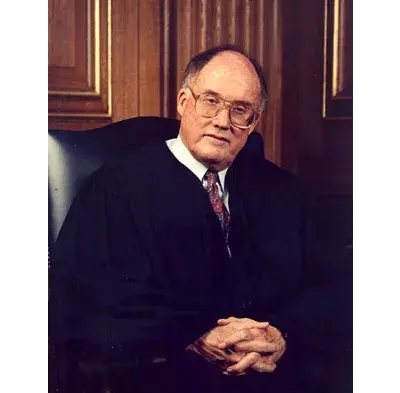
William Hubbs Rehnquist was an American lawyer and jurist who served on the Supreme Court of the United States for 33 years, as an associate justice from 1972 to 1986 and as Chief Justice from 1986 until his death in 2005. Considered a conservative, Rehnquist favored a conception of federalism that emphasized the Tenth Amendment's reservation of powers to the states. Under this view of federalism, the court, for the first time since the 1930s, struck down an act of Congress as exceeding its power under the Commerce Clause.
