John Paul Stevens Quotes
A Supreme Court justice is sometimes a liberal on one issue and a conservative on another.
John Paul Stevens, U. S. Supreme Court Justice, CNN Interview, June 13, 2011
Sourced by: Eigen's Political and Historical Quotations


This was more than a general observation at the time. Elena Kagan had just gone through difficult and extended Senate confirmation hearings to be a Justice of the Supreme Court. She was confirmed but there was a substantial Conservative opposition to her on the grounds that she had not served as a judge, although she had appeared as an attorney in many cases and as Solicitor General of the United States she argued cases before the Supreme Court. To many it was surprising that a sitting justice would so currently take a public position which could be interpreted as criticizing one wing of Congress, especially since that wing had been criticized for just playing petty politics and having no real substantive issues.


So far as he was concerned, Republican moderates—his own party members—were liberals. Anyone who did not support the extreme Conservative agenda, was an enemy and a liberal. He and the Tea Party drove almost all the moderate Republicans out of the party.


At the time, there was a very sharply divided Supreme Court with the majority consisting of very conservative justices who did not follow the principle of Stare Decisus and had overturned a number of previous Supreme Court opinions with which their ideology was in conflict.


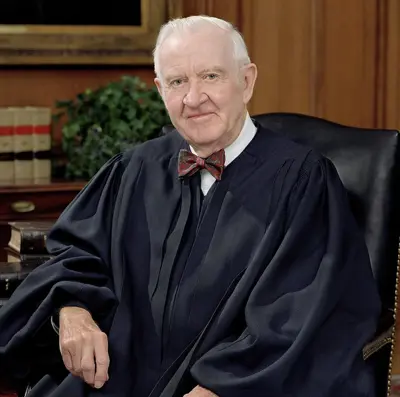
John Paul Stevens was an American lawyer and jurist who served as an associate justice of the United States Supreme Court from 1975 until his voluntary retirement in 2010. At the time of his retirement, he was the second-oldest-serving justice in the history of the court and the third-longest-serving justice. At the time of his death, he was the longest lived Supreme Court justice ever. His long tenure saw him write for the court on most issues of American law, including civil liberties, death penalty, government action and intellectual property. In cases involving presidents of the United States, he wrote for the court that they were to be held accountable under American law. A registered Republican when appointed who throughout his life identified as a conservative, Stevens was considered to have been on the liberal side of the court at the time of his retirement.
