Henry David Thoreau Quotes
A regular council was held with the Indians, who had come in on their ponies, and speeches were made on both sides through an interpreter, quite in the described mode,--the Indians, as usual, having the advantage in point of truth and earnestness, and therefore of eloquence. The most prominent chief was named Little Crow. They were quite dissatisfied with the white man's treatment of them, and probably have reason to be so.
Thoreau, Henry David. The Writings of Henry David Thoreau: Familiar Letters. Edited by F. B. Sanborn, Houghton, Mifflin, 1894, p. 446.


Not all whites were allowed to usurp all Indian lands. There were many attempts to limit white settlement to avoid friction with the Indians although the overall tendency was for the whites to take over and dominate the land.


In a tragic irony, the two chiefs were killed by a year later at the Sand Creek Massacre.


A Written form of Constitution of the first democracy of the New World.

He and the 7th Cavalry were themselves whipped and killed shortly thereafter.
The Cherokee's had fallen under the control of the Confederate military and Ross had urged Federal military protection for the tribe.


Abramoff was taking millions from the Choctaw Indians Tribe for his ‘services’ to get federal legislation so that they would not have to pay state taxes on their gambling profits. He also had other Indian tribes as clients. Privately he had no respect for the Indians and cheated them while they were trying to get unfair special treatment from the Republican controlled Congress and administration. Abramoff went to jail along with others in one of the biggest political scandals in modern America.

Marquis de Seignelay. This shows that the concept of ethnic cleansing has been around for some time. The only thing that prevented the French from implementing the plan was that they couldn’t defeat the Iroquois. There is a certain irony here in that the Iroquois were very much allied with the British even during the American Revolution. After that war, the Iroquois were run out of their traditional lands, not by the French but by the Americans. And where did they go and resettle? Up to then British Canada, the very area where the French so feared them.

Note that there was still a serious attempt to coexist with the Indians and to pay for lands that whites moved into. This would change radically in the administration of Andrew Jackson who would replace Adams.


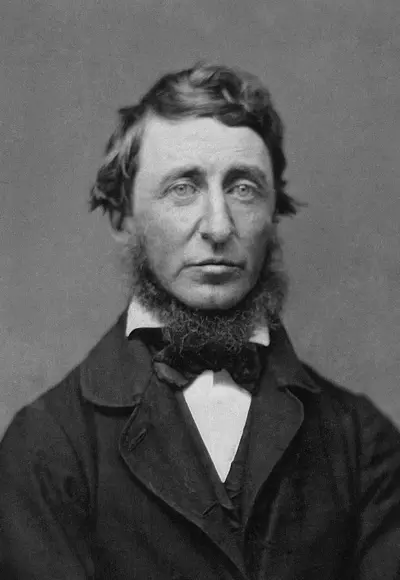
Henry David Thoreau was an American naturalist, essayist, poet, and philosopher. A leading transcendentalist, he is best known for his book Walden, a reflection upon simple living in natural surroundings, and his essay "Civil Disobedience" (originally published as "Resistance to Civil Government"), an argument for disobedience to an unjust state.
