Emily Blackwell Quotes
A man may not legally marry the minor daughter of another without his consent, but he is legally free to seduce her if he can…It would seem that our present legislation was influenced more by respect for property, than by consideration for personal protection. Virtually it is effective only in regard to the well-to-do class in which property considerations enter largely into the question of marriage. In this class the daughters live at home, under the protection of parents and family connections, to mature age. The only danger to which they are actually exposed is to that of an imprudent marriage, and against that the law fully protects them.
The age of consent for statutory rape was in some states only 10 years at the time. Blackwell was one of the many who lobbied to elevate it.
Emily Blackwell, 1826-1910, Physician, “Age of Consent Legislation,” Philanthropist, February 9, 1895
Sourced by: Eigen's Political and Historical Quotations

Even in this early era, women had their own property.

This proverb which actually has the force of de facto law in much of the Arab world, while detested by many sophisticated Westerners and Americans in particular, was actually a custom in America for many years. Under the principle, a rapist is not a rapist if he marries the girl. A seducer is not a seducer. In the Bedouin culture there is no difference between the rapist and the seducer. The reason that the practice is so hateful is that it assumes that when a woman is raped or seduced the damage is to the woman’s male relatives—to their honor. Therefore, the “crime” can be remedied by marrying the girl and satisfying the male relative’s sense of honor. Then no harm has been done, except of course to the woman who often becomes the double victim, first of the rape or seduction and then of a forced marriage. In modern America the honor of the male relatives has no standing in law, yet even today some judges and prosecutors will go easy on a statutory rapist or worse if he marries the girl and the girls family goes along with the arrangement. The term “shotgun wedding” stems from a time when family members would force the alternative on seducers.

At the time the law in the United States gave a husband control of all property of the wife including any money she might earn. In this sense the English Christian legal tradition was far less fair and modern than even Islam which guaranteed some property and inheritance rights to women.

In English law, the second a woman married, she ceased to exist and an entity independent from her husband who had total control in the family. This doctrine was carried over to American law. See {629246}.

Manava Dharma Shastra. 500 years before Christ, the Hindus took more official care of females’ property than we and most European cultures did until relatively modern times. In Anciend India, women could inherit and own property, but because of their relative inexperience and no education, they were taken advantage of by relative who were “managing affairs” for them. This text is a part of the Hindu Holy Texts. Hindus believe that Manu was a prophet whose text is revealed or inspired.
At the time in most of the United States there was no age of consent and no laws against statutory rape.

This proverb is a large part of the conceptual basis of the concept of honor killing. It starts with the notion that women are property. However, being animate property women are in the same class as livestock. And if a camel or a donkey get lose and does damage, the owner is responsible. So if a woman does something wrong, it is the father or the husband who is responsible. Since sexual behavior of most kinds is contrary to the Islamic custom and law, any activity in this regard, demonstrates that the father of husband has not been up to his obligations and is therefore dishonored. Therefore, the least he can do, to provide a deterrent to other women is to kill the offending female. Without the concept of property, the entire chain of logic collapses under its own weight.


As hard as it is for us to imagine today, while her husband was President of the United States, the First Lady wrote a nationally syndicated newspaper column every single day with politics frequently the subject. While she usually agreed with the President, there were occasions where they seemed to not see things exactly the same. She tended to be more liberal than he. However, there were those who believed that when she criticized politicians, it was with FDR’s knowledge and blessing and she sometimes did his “dirty work.” Eleanor Roosevelt was one of the most influential people in the country—certainly more-so than any First Lady before and since.
Note, that like other feminist leaders of the time, she viewed the fetus as a person. However, between the economic pressures and the illegality of birth control devices and information provision, abortion was a critical decision that had to be faced by many women. Later, feminist leadership had to come to grips with the issue of who makes the decision in these areas, and placed the right of the woman to make these decisions, as opposed to husbands, fathers and government, as the highest priority. Then, when the drivers for abortion could not be eliminated, it was women who were criminalized. Feminists then fought for the right of abortion and the right of the woman to make decisions, but feminine leadership has never—in America—been advocates of abortion as opposed to the right of abortion, a subtlety that often is lost.


This is the biblical passage which causes so much trouble in modern society. Literal adherence to this passage produces a sexist environment which is at odds with many modern norms of fairness and equity. Thus, religious fundamentalists are in conflict with most others. At the same time this passage serves as a justification of sexism for some.

A daughter’s behavior is a reflection of the family and its honor. If a girl is unchaste, it is the duty of the father or other male relatives to kill the girl. However, this proverb warns about hearsay and gossip causing action which would have been unjust and regretted later.


The church advised this to its members


The law at that time gave a married woman almost no rights. The husband legally controlled the family assets regardless of who had earned or provided them. He aslo had absolute control of the upbringing of the children. Women could not vote and in many states were considered property of the husband.

This is a very interesting historical quotations in that it describes the family culture of an important subset of Americans in the early 19th century. The Duena (chaperone) was a middle aged woman who would always accompany young, unmarried women whenever they left the home. A young man who would take a young lady for a carriage ride or anything else, would also have to take the duena.

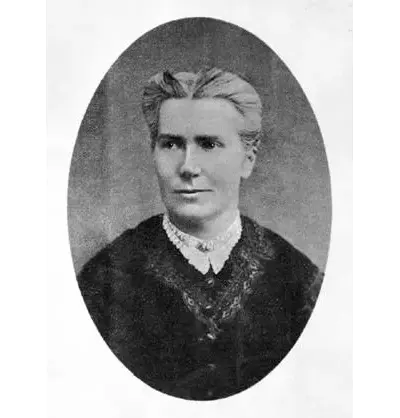
Emily Blackwell was the second woman to earn a medical degree at what is now Case Western Reserve University, and the third woman (after her sister Elizabeth Blackwell and Lydia Folger Fowler) to earn a medical degree in the United States. In 1993, she was inducted into the National Women's Hall of Fame.
