Elizabeth Cady Stanton Quotes
When we consider that women are treated as property, it is degrading to women that we should treat our children as property to be disposed of as we see fit.
Note, that like other feminist leaders of the time, she viewed the fetus as a person. However, between the economic pressures and the illegality of birth control devices and information provision, abortion was a critical decision that had to be faced by many women. Later, feminist leadership had to come to grips with the issue of who makes the decision in these areas, and placed the right of the woman to make these decisions, as opposed to husbands, fathers and government, as the highest priority. Then, when the drivers for abortion could not be eliminated, it was women who were criminalized. Feminists then fought for the right of abortion and the right of the woman to make decisions, but feminine leadership has never—in America—been advocates of abortion as opposed to the right of abortion, a subtlety that often is lost.
Elizabeth Cady Stanton, 1815-1902, First President, National Woman Suffrage Association, View on abortion, Letter to Julia Ward Howe, October 16, 1873
Sourced by: Eigen's Political and Historical Quotations


The following year, women got the right to vote, the first nation to reach that level of enlightenment.
This proverb is a large part of the conceptual basis of the concept of honor killing. It starts with the notion that women are property. However, being animate property women are in the same class as livestock. And if a camel or a donkey get lose and does damage, the owner is responsible. So if a woman does something wrong, it is the father or the husband who is responsible. Since sexual behavior of most kinds is contrary to the Islamic custom and law, any activity in this regard, demonstrates that the father of husband has not been up to his obligations and is therefore dishonored. Therefore, the least he can do, to provide a deterrent to other women is to kill the offending female. Without the concept of property, the entire chain of logic collapses under its own weight.


Some modern versions of the Koran annotate the “beating” injunction and argue that this should only be used as a last resort. This is an example of socially unacceptable anachronisms that are found in the scripture of most older religions. All but the radical fundamentalists do not take these passages literally.

Stewart a Black, female journalist wrote at a pre Civil War time when most people were little interested in the writings of either Blacks or women.


Many leaders of nations are in denial about this problem which exists almost everywhere. In Israel, the problem is compounded because the very orthodox Jews and Muslims both come from a tradition where women are allocated a place subservient to men in many ways and to some (like some Christians) there is a perceived duty to discipline wives and daughters. So reform involves religious tradition and theology.

The Act allowed women and other workers who were the victims of wage discrimination to sue the discriminating employers even after the statute of limitations and run out provided that they victim had no knowledge of the discrimination. Lilly Ledbetter was a Goodyear Supervisor who was for years paid far less than the male supervisors doing the same work. But the company kept it secret and Ms. Ledbetter didn’t find out until the statute of limitations had said she could no longer sue. The Lilly Ledbetter Act corrected that injustice. President Obama observed that discrimination in pay affects not only the woman or other worker, but also the entire family which might therefor not be able to obtain health care, education, or care for elderly parents. At the time that this quotation was made, white women in America who were working full time were earning only 77 percent of what men earned. For minority women, the proportion is even less. As bad as that was, it was an improvement over the situation when the equal pay act was passed 50 years before. Then, women earned only 53 percent of what a man did.

Jinnah was a modern Islamic reformer as this quotation demonstrates. Pakistan is not as backward as most of the Arab Islamic countries on the role of women. There are many Pakistani businesswomen and professionals. Pakistan has even had a female president. However, the fundamentalist Islamic forces that dominate the culture constantly preach and advocate the literal interpretation and following of Sharia which calls for a traditional, subservient traditional role for women; “honor killings” are common; “a rapist cannot be convicted on a female victims testimony; there are calls for the killing of adulteresses and other primitive throwbacks. Jinnah’s vision has not come to pass yet.


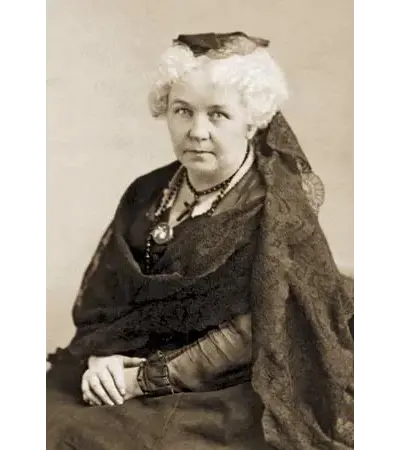
Elizabeth Cady Stanton was a leader of the women's rights movement in the U.S. during the mid- to late-1800s. She was the main force behind the 1848 Seneca Falls Convention, the first convention to be called for the sole purpose of discussing women's rights, and was the primary author of its Declaration of Sentiments. Her demand for women's right to vote generated a controversy at the convention but quickly became a central tenet of the women's movement. She was also active in other social reform activities, especially abolitionism.
