Mary Astell Quotes
If “all men are born free,” how is it that all women are born slaves?
Mary Astell, 1666-1731, Philosopher and Polemicist, Some Reflections on Marriage, 1700
Sourced by: Eigen's Political and Historical Quotations


The following year, women got the right to vote, the first nation to reach that level of enlightenment.
Women were not, in the decisions of Canadian courts “Persons.” As such they were not allowed to serve as public officials and legislators. In 1929 the Judicial Committee of the Privy Council reversed previous interpretations and declared women eligible for all public offices. It became known as “The Persons Case.”


The issue of slavery which had been suppressed in Congress for the first decades of the nation broke out when Missouri statehood was considered. By previous agreement, slavery was not even discussed in Congress but the time period elapsed. Tallmadge not only proposed that no more slaves could come into Missouri {613176} but most shocking to the Southerners was that every person born in the new state would be free at the age of 25. In a generation, there would be no more slavery in Missouri and there would be no economic compensation for slave owners at all. The House of Representatives accepted the amendment, but it failed in the Senate. At that time, Senators were not elected by voters but were appointed by the state legislators and the Southern slave states had a disproportionate share of the senate from a population point of view. But what this quotation shows clearly that a majority of the country in 1819 were opposed to slavery and were willing to end it without compensation.

Jinnah was a modern Islamic reformer as this quotation demonstrates. Pakistan is not as backward as most of the Arab Islamic countries on the role of women. There are many Pakistani businesswomen and professionals. Pakistan has even had a female president. However, the fundamentalist Islamic forces that dominate the culture constantly preach and advocate the literal interpretation and following of Sharia which calls for a traditional, subservient traditional role for women; “honor killings” are common; “a rapist cannot be convicted on a female victims testimony; there are calls for the killing of adulteresses and other primitive throwbacks. Jinnah’s vision has not come to pass yet.


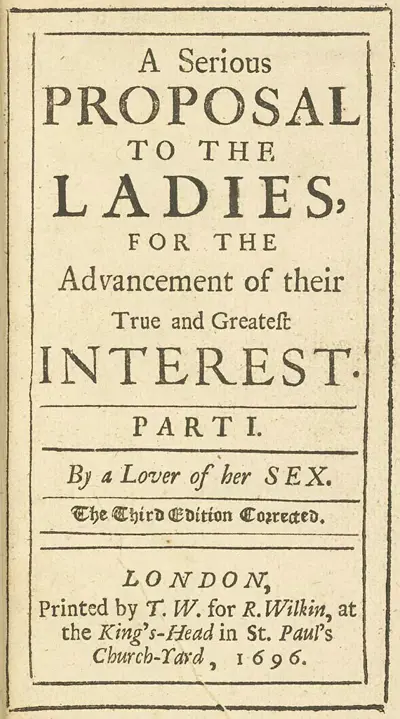
Mary Astell was an English protofeminist writer, philosopher, and rhetorician. Her advocacy of equal educational opportunities for women has earned her the title "the first English feminist."
