George W. Bush Quotes
A great nation does not hide its history. It faces its flaws and corrects them.
Comment on the opening and dedication of the National Museum of African American History, Washington DC, September 24, 2016
Sourced by: Eigen's Political and Historical Quotations

The issue of slavery which had been suppressed in Congress for the first decades of the nation broke out when Missouri statehood was considered. By previous agreement, slavery was not even discussed in Congress but the time period elapsed. Tallmadge not only proposed that no more slaves could come into Missouri {613176} but most shocking to the Southerners was that every person born in the new state would be free at the age of 25. In a generation, there would be no more slavery in Missouri and there would be no economic compensation for slave owners at all. The House of Representatives accepted the amendment, but it failed in the Senate. At that time, Senators were not elected by voters but were appointed by the state legislators and the Southern slave states had a disproportionate share of the senate from a population point of view. But what this quotation shows clearly that a majority of the country in 1819 were opposed to slavery and were willing to end it without compensation.

For more about the Bureau. See {629185}.and {629187}.


It was indeed the first government that was ever founded on that fallacious principle. In retrospect, it was amazing that more Southerners did not question why no other government in the history of the world based a society on that principle. The Southern hubris was a great failing for them.

The president was commenting on a Donald Trump campaign statement that African American were in the worst shape in history when the reality was just the opposite

After the Civil War and Reconstruction, the American nation was still bitterly divided intelelctually, socially, emotionally and poliotically. In an effort to bring more unity to America, most of the power stucture and the influentials of the nation began to avoid those issues that would divide North and South and try and promote a narrative that both sides might be able to live with. And this is what Zeitz describes in this quotation. America went through a period of Revisionist History that even in the 21st century was held by many people. It wasn't until the middle of the 20th century that the real history and narrative of the Civil War and Reconstrution emerged from the few academics who had all along criticized the fabricated narritive that did unify the country at the cost of historical accuracy and truth. Many scholars point out that the price that America paid for this unity was the Jim Crow era and a century of legalized racism. Much of the nation was built on the labor of Negro slaves and the victims of the slavery era, also bore the brunt of American unity and reconcilliation.

Many believe that the Confederate flag symbolizes bravery and honor in battle, and therefore should be flown even in state government facilities as these are values which our governments hold. And that is true, but the same symbol also connotes, slavery, murder, racism, treason, hate, family destruction, brutality, and torture. Southern whites tend to acknowledge the bravery and honor but ignore the negative symbols. Most other Americans acknowledge the negatives but many tend to ignore the positive virtues.
As just one example of Southern States' reasons, see {583044}. Many of the Northern States had passed laws declaring everyone in the state was free and making it illegal to return or assist in the returning of escaped slaves. The Southerners got the Federal Fugitive Slave Act passed which required all Americans to assist in recapturing escaped slaves. It was the Northern States who claimed states' rights were being trampled. The South was vehemently opposed to States' Rights when it came to allowing individual states to decide who was free and who was not. The Southerners had only one fundamental reason for secession—the maintenance of the Negro slavery system on which much of their economy depended as did their sociology, culture, and way of life.


For many years after the Civil War, in an effort to dignify the Southern rebellion, it was fashionable to ignore or skim over the institution of slavery in American history. Government, in particular regarded the issue as divisive even a century after the Emancipation Proclamation.


The first sentence is inscribed on the Jefferson Memorial in Washington DC. The last two sentences are rarely quoted.

Like so many of his other predictions about America, he saw that the evil of racism and slavery was bound to cause the nation to implode. And this was decades before the Civil War, but the problem was inescapable to a critical observer like de Tocqueville.


The card was issued to all American troops in the theater. Similar versions were distributed to troops in Iraq, and other Arab countries.


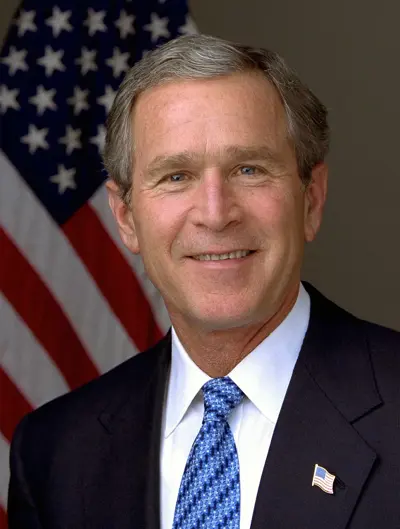
George Walker Bush is an American politician and businessman who served as the 43rd president of the United States from 2001 to 2009. A member of the Republican Party, Bush previously served as the 46th governor of Texas from 1995 to 2000. He was born into the Bush family; his father, George H. W. Bush, was the 41st president of the United States from 1989 to 1993.
