Mahatma Gandhi Quotes
You must face the bloodbath and accept it.
A very passionate minority of India’s Muslims demanded a separate Islamic State (what would become Pakistan) but Hindu’s and Muslims were mixed throughout India and many Indians and British were concerned that there would be a bloodbath if the plans for independence went forward. Gandhi desperately tried to avoid violence but thought that independence was so important that the sectarian violence should not be an excuse for continued British rule. Unfortunately, millions of Indians were killed in the riots and ethnic cleansing and revenge that followed independence. Since then there has been much second guessing on how else the situation might have been handled.
Mohandas K. Gandhi, 1869-1948, Indian political & spiritual leader, Statement to the last Viceroy of India, Louis Mountbatten about the British declaring Indian Independence, 1947
Sourced by: Eigen's Political and Historical Quotations

Jinnah and other Muslim leaders had stirred up the Muslims to violence to put pressure on all the parties to accede to Jinnah's Muslim League's demand of an independent Muslim nation—Pakistan. Messervy was very sympathetic to the Muslim leadership as he had been feuding with and frustrated by the predominantly Hindu ruling Congress Party. After partition he accepted the mercenary position of Commander in Chief of the Pakistani Army. Then he was shocked and horrified at the slaughter of the terrorist attacks by the Muslims—about 4,000 Sikh men, women and children had been beaten and cut to death. The Sikhs had been targeted largely because Sikh leaders had recently announced that if there were a Partition, Sikhs would refuse to live in nation under Muslim control.

The Sultan, led 17 different military expeditions to India to spread the Muslim faith He is one of the few major conquerors of the world who was never defeated in Battle. He conquered the Lahore area and others of India that became Muslim and eventually became Pakistan. He was the first Islamic leader to bear the Title of Sultan demonstrating the separation of the civil power from the Caliph.
A very passionate minority of India’s Muslims demanded a separate Islamic State (that would become Pakistan) but Hindu’s and Muslims were mixed throughout India and many Indians and British were concerned that there would be a bloodbath if the plans for independence went forward. When the decision had been made to partition India, Radcliffe had the unenviable task of deciding where the boundary was to be between Pakistan and India. No one on either side was satisfied with his effort. So, realizing that violence was about to break out, he packed quickly and went back to England. Over two million Indians were killed in the violence that broke out in the next weeks as there was a huge migration and ethnic cleansing to implement Radcliffe’s boundaries. Fifty years later, both India and Pakistan acknowledge that Radcliffe did a very reasonable job.

The British wanted to turn over control of India to Nehru's Congress Party and make India independent. However, there had been sectarian rioting and murder between Muslims and all the other religions of India—Hindus, Sikhs, Buddhists, and Christians. Wavell was not confident that Nehru and Congress could control the situation and huge massacres would result. Gandhi, who normally did everything to avoid violence, this time placed Indian independence first and demanded continuation of the complete transition process including the police and military powers. This is one of the very few occasions on which non-violence was not pre-eminent for Gandhi.

Churchill was reported to be so angry and exasperated that his face turned red and he was sputtering. During World War II, Gandhi, Nehru and other Indian Nationalists were leading protests against British control of India. This not only bogged down British soldiers surprising the nationalists rather than fighting in Burma or in other war theaters, but India supplied a huge number of battalions to the British Army the world over and if that manpower dried up, the allied war effort would suffer. The American State Department wanted Churchill to announce that after Japan was defeated, there would be a process toward self-government. This way, they thought, the Indians would redouble their effort to defeat the Japanese and stop the then current protests and strikes. Churchill was strongly opposed to any diminution of the British Empire, but beyond that, he knew India quite well and realized that at any hint of Independence the large Muslim minority in India would insist on autonomy or a partition of the country and use sectarian violence and terror to intimidate the Indian Congress party and the British, but the major victims of the terror—the Hindus and the Sikhs would not remain passive, but would retaliate in kind. President Roosevelt was in the midst of planning the Normandy Landings of the D-Day invasion and did not want to pressure Churchill and the British at this point in time, so the door to independence was not opened during the war and Britain had to deal with the protests throughout. However, when, after the war, the Labor Government, started a process toward Indian independence which resulted in exactly what Churchill predicted. At least 2 million Indians were slaughtered in the internecine terrorist cycles of fear and retaliation motivated terror attacks what were so extensive that the British military could not really control it.


The Christian Crusaders had captured Jerusalem and slaughtered the Muslim civilian inhabitants. In the 21st century, some Islamic terrorists justified the beheading of captured Christian prisoners as revenge for this massive Christian beheading of Muslims almost 1,000 years earlier.

Muslim League leaders wanted to stir up India's Muslims in order to prevent Indian Independence from Britain unless India were partitioned and the Muslims could have their own nation. At that point the British and the Congress Party of India—the majority political party were both starting to plan for independence. Most of the Muslim nationalists did not want to have any Muslims living in a Majority Hindu nation. To stop it, they first used fear claiming that when the British left, the Hindus would massacre all the Muslims. They galvanized the Muslims to first attack the Hindus to dissuade then from their attacks which at that point were imaginary except in the conspiracy theory of the Muslim League. The moral logic of this statement was similar, albeit not to the same bloody degree, as the famous quotation of Presidential Candidate Barry Goldwater on extremism." H. S. Suhrawardy


Two months earlier, Jinnah and the Muslim League had, behind the scenes, orchestrated and abetted vicious, murderous, terrorist attacks on Sikhs by Muslim tribesman brought into the Punjab for the purpose." Master Tara Singh

The White Boers viewed themselves as superior to the Blacks and the Blacks and Whites competed for land. In an early form of ethnic cleansing, the Boers attacked the undefended women and children of the Black tribes. The authorities opposed these atrocities but did not have any way of enforcing their orders.
14 Arab Armies in a coordinated attack on the 1 day old Israeli state, intended to massacre all the Israelis as demonstrated by this quote. Note that this kind of extermnination intent was advertised with pride. To everyone's surprised, the Jewish defenders not only beat back the viscious attacks but enlssarged their terroitory by capturing strategic sites from which the attacks had been launched. Many people credit to the Israely victory to the fact that they were litterally fighting for their lives. Defeat would have meant death for them and their families. The Arab armies, in contrast, were fighting for land that other Arabs claimed that should have been theirs. The willingness to stand and fight for this goal did not match the self preservation that motivated the Israelis--especially in the aftermath of the Holocaust killing 6 million Jews in WWII.
There are some who argue that the quotation was made earlier and was not meant as an incendary call for massacre of Israelis. It well may be that in his original thinking, he was predicting what would happen if the State of Israel was created, basing his thoughts on historical artrocieties of the past. And many think he was concerned about that possible outcome and was trying to avoid it. The import of the quotation was not necessaruly to hisltorically blame Assam for the point of view but to simply establish that there were many Arab voices calling for victories of history where there were massacres in the Middle East. And there were those who took Azzam's quotation and broadcasted it on Arab radio, calling for the very massacre that Assam may have been warning about. Note that this notion of Jewish massacre and extermination was also picked up 60 years later and called for by the President of Iran.

He was then a young Lieutenant.
Prior to whites settling in America, various Indian tribes had a long history of fierce fighting for control of Kentucky. The Transylvania Land company negotiated for the “rights” to Kentucky. Dragging Canoe, who opposed the treaty, argued that the land had a bad history and would be very difficult to settle. Poet Theodore O’Hara described Kentuckians as “Sons of the Dark and Bloody Ground” in his poem, The Bivouac of the Dead.
He was a German physician and explorer who had converted to Islam. Nonetheless, he was caught up in the Arab uprising of the Madhists, who had conquered much African territory.

The Philippine-American War was terribly brutal. In response to insurgent atrocities against American soldiers, some of the Americans also adopted brutal tactics including torture and mutilation. Washington had heard stories of this improper behavior in the part of some American troops and instructed the senior officers to investigate and discipline the men if the reports were true. Unfortunately some of the senior officers covered up the illegal and criminal behavior of some Americans. This quotation was taken from a New York Times report on a representative of the Red Cross who went to the Philippines at the invitation of the insurgents. He generally found serious atrocities by some of the soldiers on both sides but by no means all of the combatants. General Otis, the U. S. Commander tried to keep Blake out, and had him detained away from the battle areas for some weeks where he was “educated” about the enemy atrocities. Finally Blake got to the field and reached the insurgent commander who had invited him. His report generally praised the American troops, but spared no details when there were guilty of atrocities.
With the partition of India forming an independent Pakistan, ethnic riots broke out and millions of people were killed. This joint statement was issued to try and quell the violence but it had progressed too far. Jinnah as a political ploy to obtain the partition organized Muslims and threatened violence—see {627153} and {627169}. Things got out of hand with ethnic cleansing being an objective in many localities—see {627146} and {627149}.
The German catastrophic classification of people as superior and inferior did not start with the Nazis. It had been part of the German culture. What many feel makes Bismarck more cold-blooded than most Germans is that the latter were led to a hatred of the other ethnicities and would exterminate them for that reason, but Bismark had sympathy for the Poles yet advocated genocide simply on practical grounds. The analogy with the wolf shows this mentality at its worst.


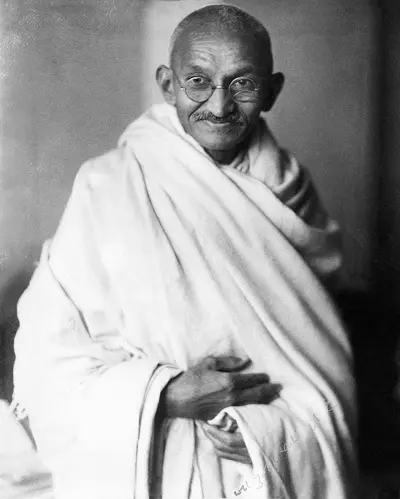
Mohandas Karamchand Gandhi was an Indian lawyer, anti-colonial nationalist, and political ethicist, who employed nonviolent resistance to lead the successful campaign for India's independence from British rule, and in turn inspired movements for civil rights and freedom across the world. The honorific Mahātmā (Sanskrit: "great-souled", "venerable"), first applied to him in 1914 in South Africa, is now used throughout the world.
