Mahatma Gandhi Quotes
If India wants her bloodbath, she shall have it.
The British wanted to turn over control of India to Nehru's Congress Party and make India independent. However, there had been sectarian rioting and murder between Muslims and all the other religions of India—Hindus, Sikhs, Buddhists, and Christians. Wavell was not confident that Nehru and Congress could control the situation and huge massacres would result. Gandhi, who normally did everything to avoid violence, this time placed Indian independence first and demanded continuation of the complete transition process including the police and military powers. This is one of the very few occasions on which non-violence was not pre-eminent for Gandhi.
Mohandas K. Gandhi, 1869-1948, Indian Political and Spiritual Leader, Statement to the English Colonia Viceroy of India, Archibald Percival Wavell, 1883-1950, August 27, 1947
Sourced by: Eigen's Political and Historical Quotations

Churchill was reported to be so angry and exasperated that his face turned red and he was sputtering. During World War II, Gandhi, Nehru and other Indian Nationalists were leading protests against British control of India. This not only bogged down British soldiers surprising the nationalists rather than fighting in Burma or in other war theaters, but India supplied a huge number of battalions to the British Army the world over and if that manpower dried up, the allied war effort would suffer. The American State Department wanted Churchill to announce that after Japan was defeated, there would be a process toward self-government. This way, they thought, the Indians would redouble their effort to defeat the Japanese and stop the then current protests and strikes. Churchill was strongly opposed to any diminution of the British Empire, but beyond that, he knew India quite well and realized that at any hint of Independence the large Muslim minority in India would insist on autonomy or a partition of the country and use sectarian violence and terror to intimidate the Indian Congress party and the British, but the major victims of the terror—the Hindus and the Sikhs would not remain passive, but would retaliate in kind. President Roosevelt was in the midst of planning the Normandy Landings of the D-Day invasion and did not want to pressure Churchill and the British at this point in time, so the door to independence was not opened during the war and Britain had to deal with the protests throughout. However, when, after the war, the Labor Government, started a process toward Indian independence which resulted in exactly what Churchill predicted. At least 2 million Indians were slaughtered in the internecine terrorist cycles of fear and retaliation motivated terror attacks what were so extensive that the British military could not really control it.

With the partition of India forming an independent Pakistan, ethnic riots broke out and millions of people were killed. This joint statement was issued to try and quell the violence but it had progressed too far. Jinnah as a political ploy to obtain the partition organized Muslims and threatened violence—see {627153} and {627169}. Things got out of hand with ethnic cleansing being an objective in many localities—see {627146} and {627149}.


This quotation illustrates degree of hatred that the French had for the English for the hundreds of years of their European superpower rivalry.


Although Great Britain had abolished slavery, British economic interests during the Civil War suffered because of the northern blockade of the South. Much political opinion in England was hostile to the blockade policies of the Union. Bright, a great admirer and supporter of the United Sates and the Union cause was concerned that the United States might drift into War with Great Britain. His letter to Senator Sumner was written with the understanding that it would be in shared with President Lincoln, and it was actually read at a cabinet meeting.
The Muslim League was demanding that the Punjab become a part of Pakistan when independence was granted later. However, the Hindus, Sikhs, Buddhists, and Christians were all adamant that they would not live in a Muslim nation which would soon become a de facto theocracy if the British could not control them. The Punjab was divided between India and Pakistan, and hundreds of thousands died in Sikh-Muslim attacks and then Hindu-Muslim conflict in the Punjab.

He was echoing proposals that he made in the Delhi Emergency Committee that had been called to cope with the butchery and murder when the Hindus and Sikhs were trying to leave the areas that were to be part of Pakistan under the Partition and the retaliations against the Delhi Muslims who were trying to flee to the new Pakistan. Unfortunately, the Muslim leadership did not want such a truce as while the land had been partitioned, Indian Money, military equipment, and other resources were yet to be divided and the Muslim leaders who had been so successful playing the violence card to gain and independent Pakistan, did not want to give up that option in the remainder of the division of India. Also, it was not at all clear that the Muslim political leaders could even then control the mobs who they had already whipped up to violence.

At the time the President denied that he had decided to invade Iraq. Skelton saw the “handwriting on the world.”

Over the years Sherman’s advocacy of Indian extermination went beyond the Sioux to all Indians.
Confederate General Wheeler had introduced a new tactic of mining the roads with improvised explosive devices which took their toll on Sherman’s troops. At the time, this was against the ruled of war. Sherman ordered a few Confederate prisoners to the front and required them to walk ahead of his troops and demine the roads. He then allowed some of the prisoners to return to General Wheeler with a note from Sherman, explaining that if the Confederates persisted in this unethical form of warfare he would march all of the Confederate prisoners in the front of the troops and force them do remove the explosives by hand regardless of the danger. Wheeler never planted land mines again.
A very passionate minority of India’s Muslims demanded a separate Islamic State (what would become Pakistan) but Hindu’s and Muslims were mixed throughout India and many Indians and British were concerned that there would be a bloodbath if the plans for independence went forward. Gandhi desperately tried to avoid violence but thought that independence was so important that the sectarian violence should not be an excuse for continued British rule. Unfortunately, millions of Indians were killed in the riots and ethnic cleansing and revenge that followed independence. Since then there has been much second guessing on how else the situation might have been handled.


The throwing of flaming torches to burn out members of the other religion got out of control and the fires spread to the homes of all residents. The fires were so prevalent that the riot was then and has since been referred to as the "Shahalmi Gate Blaze". At the time Jinnah was horrified at the violence, but by the following year he and other Muslim League leaders were aiding and abetting Muslim terrorist attacks to put pressure on the government to create a separate Muslim state upon Indian independence—Pakistan. Most historians agree that the Muslim terrorism in the short run had worked, as it would have been unlikely that India would have been partitioned in the absence of violence. However, it set in motion a cultural pattern of religious hate, bigotry, intolerance, violence and murder which would plague Pakistan thereafter. The politicians throughout the country's history have tried to use the Muslim religious, fundamentalist, extremists for their purposes only to find that the fanatics were out of control and the entire Pakistani population has lived in fear, lest an extremist decide that what they did or say was inimical to Islam and assassinate him or her. They have assassinated even the highest levels of politicians—President, Governors of Provinces, National Legislatures as well as Journalists, writers and academics. But the average Pakistani citizen has always been at risk of brutal murder with hundreds killed every year in an atmosphere of total impunity for the murderers. They have even murdered married women who had been raped on the grounds that they were adulterers and were therefore stoned.


A privately produced anti-Muslim video was used by Muslim activists throughout the world to whip up violent protests of the United States, Many people were killed. The President was explaining to world leaders the Western view of the importance of protecting free speech, even that which is blasphemous or hateful. One problem of course is that the Islamic holy scripture, The Koran, requires that a blasphemer be put to death. The Jewish and Christian Old Testament proscribes the SAME punishment, and there have been American Christians who have called for a return to literal Mosaic Law. Also ultra-orthodox Jews in America and Israel. The difference of the West is that literal interpretation of the Bible has been given up and the various Biblical Death penalties (including disobedient children and adulterers) and much of the Muslim world has not. For most of the West, democracy has tempered literal religion. For the Islamic world, literal religion has inhibited and obstructed democracy.
This is a direct repudiation of the Christian doctrine. Ironically, it is the believe and behavior of must people who call themselves Christian. This was written under the name of Ragnar Redbeard. There are a few scholars who believe that it was written by Jack London, but most credit Desmond.

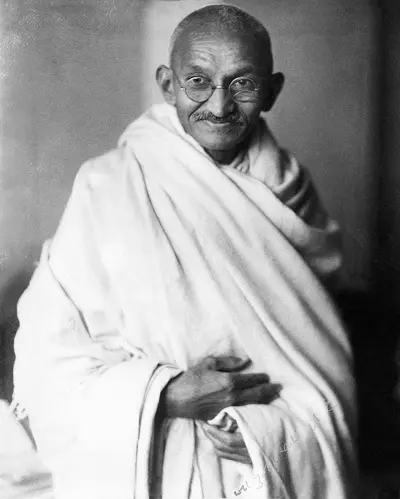
Mohandas Karamchand Gandhi was an Indian lawyer, anti-colonial nationalist, and political ethicist, who employed nonviolent resistance to lead the successful campaign for India's independence from British rule, and in turn inspired movements for civil rights and freedom across the world. The honorific Mahātmā (Sanskrit: "great-souled", "venerable"), first applied to him in 1914 in South Africa, is now used throughout the world.
