John Wesley Quotes
You cannot but expect, that the offence continually arising from such a variety of provocations [reforming current religious groups] will gradually ripen into hatred, malice, and all other unkind tempers. And as they who are thus affected will not fail to represent you to others in the same light as you appear to them, -- sometimes as madmen and fools, sometimes as wicked men, fellows not fit to live upon the earth; the consequence, humanly speaking, must be, that, together with your reputation, you will lose, first, the love of your friends, relations, and acquaintance, even those who once loved you the most tenderly; then your business, for many will employ you no longer, nor buy of such an one as you are;and, in due time, … your health, liberty, and life.
Rarely has a reformist or revolutionary leader been so candid about the effects of their efforts on their followers.
John Wesley, 1703-1791, English Cleric and Founder of Methodism, Advice to a People Called Methodist, October 10, 1745
Sourced by: Eigen's Political and Historical Quotations


We was asked to recant his “heretical” ideas and he would be freed. He was finally freed without recanting and when he established Pennsylvania there was freedom of conscience for all, not even common then in the American Colonies.


Toynbee was very active in attempting to reform the Church of England.

In August 1819 there was a reform political rally in St. Peter’s Field of Manchester. The authorities wanting to censor the reform contents sent the police to break up the meeting. The police killed 11 people and wounded hundreds more in what became known as the “Peterloo Massacre”. Carlile, who publicly condemned the massacre, was one of the heroes of freedom of the press. He was jailed frequently for publishing anti government or anti Church of England criticisms, as were his wife and sister. The government grew so desperate trying to censor his publications that they placed a high minimum price on the sale of all newspapers assuring that the average citizen could not afford to buy the “seditious and blasphemous material.” In addition to press freedom he was an early reformer for birth control, religious freedom, women's suffrage and rights (which he called for in the 1820s), and against child labor.

Starting with the Crusades, the Popes began giving indulgences to those who would die in battle fighting for a holy cause. The Papacy was then at one of it’s lowest points. Two men, Clement and Urban, both claimed the Papacy and each had raised an army to fight the other. Each was promising indulgences to those who would fight, and in a modality similar to the Muslim terrorists of the 21st century, the soldiers were promised ascendancy to Heaven if the fell in battle for such a holy cause. Wycliffe, in a wonderfully original notion, proposed that the people who live in peace be granted the indulgences. See {618086}.

Most people are familiar with the people are familiar with the terrible persecution of the Jews in Spain by the Christians. Although there were a few examples of tolerance to Jews by Muslims when they controlled Spain and instances like modern Turkey. Generally however there is and has been Islamic persecution of Jews, Christians, and other non Muslims in almost all nations where Muslims have been in control. Until the Enlightenment, Christian persecution of other religions was just as bad if not worse.

This is a particularly interesting historical quotation because it succinctly gives a history of the various horrors of religious strife in British history—a history that was very well known to the American Founding Fathers and the general American Colonial population. This history was the major driver behind the public insistence for the Bill of Rights and the 1st Amendment which erected a wall of separation between church and state with government never favoring or abetting any particular religion.


New Ross was under siege by Cromwell and his English Parliamentarian troops. After two days, the town tried to negotiate terms of surrender and one of the main things they asked for was freedom of religion to practice Roman Catholicism. This famous response set the stage for religious bigotry over the next years. Cromwell’s reasons for not allowing Catholicism to be practiced was not only one of religious zeal. At the time, the Roman Catholic Church was a major geopolitical power under a Pope who commonly supported or even dispatched troops for geopolitical and religious ends. The Vatican was particularly resentful of England for separating from the Church and asserting that the King of England was the head of the Church and not the Pope. Therefore Cromwell and many Englishmen had to deal with the reality that every practicing Catholic in the realm was a potential spy, traitor, and/or rebel. This fear of control of countries by the Pope strongly affected America, and was responsible for the defeat of the first Catholic Presidential Candidate, Al Smith. It was also a major factor in the election of John F. Kennedy so he dealt with it head on.

Wesley had been to Island several times and was interested in affairs there. He was a strong advocate of freedom of religion but the violence of the earlier religious conflict made him very wary of the Irish Roman Catholics who seemed to him particularly prone to religious violence.

1st Earl of Strafford

See {639434}, {639436}, and {639437} for the triggers to this report.

The Barbary Pirates had an incredible extortion racket going in the Mediterranean. If nations would pay them an annual sum each year, they would not attack and seize merchant ships of that country and sell the ships and goods while holding the sailors for ransom.

The Netherlands and Belgium then belonged to Spain. However, Protestantism was spreading to the Netherlands. The Duke was a Catholic fanatic and advised the King to send him and an army into the Lowlands to root out and kill the heretics. In contrast, the Duke of Feria counseled allowing the lowlands tolerance. The King, himself a bloody fanatic sent Alba with the army. Over the next decade he murdered and executed thousands of Protestants and many Catholics who were more tolerant and thought Alba, who was given the derogatory nickname of “The Iron Duke. Ironically, this led to the Lowlands revolting and gaining independence from Spain.
English history has been replete with Catholic-Protestant conflict and because of the British Empire, the British historians were very familiar with the Islamic conflict with Christianity, Judaism, Hinduism, and other religions. Toynbee was very worried about the future religious struggles and he turned out to be right. Freedom isi amenable to different interpretations and compromise. Religion also has different interpretations, but many of the religious fundamentalists see compromise as an offence to God and his word. So religion is less amenable to political, civil or social structuring and compromise.

He had whipped the crowd up into a feverish pitch until someone rushed the bound and tied blacksmith and stabbed him to death. He had only criticized Mathias for being too harsh and stern a leader.


“Manumitting” means the freeing of slaves. See Quotation 643600 for Laurens’ view of slavery despite the fact that he was a substantial slave owner. He was willing to lose the money represented by the value of his slaves, but most slave owners self interest was to the contrary. One of the most interesting thing about this quotation is the fact that Laurens received so much opposition from his fellow South Carolinians and other Southerners despite the fact that only Laurens would lost money by freeing his slaves. Even slave owners who wanted to do the right thing and were willing to lost the money were under enormous social and political pressure not to free slaves.

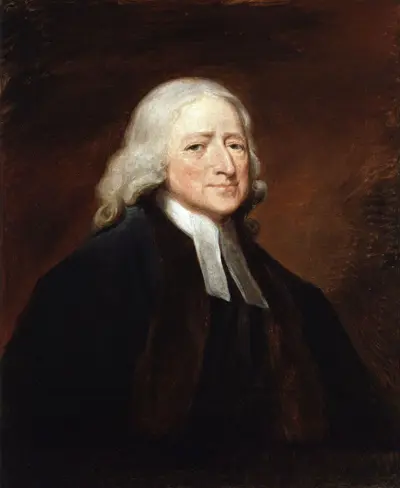
John Wesley was an English cleric, theologian, and evangelist, who was a leader of a revival movement within the Church of England known as Methodism. The societies he founded became the dominant form of the independent Methodist movement that continues to this day.
