Newt Gingrich Quotes
You cannot be the arsenal of democracy if you don’t have an arsenal. We must build up our manufacturing base.
“Arsenal of Democracy” is the famous FDR phrase whereby America was able to provide weapons for the other democracies to fight Fascism. At the time, the United States had the greatest manufacturing capability of the world. When Gingrich made this quotation, much manufacturing that had been done in America had moved offshore. However, one area that did not move offshore was military weapons manufacturing where the United States manufacturing capability was thriving but America was the largest arms manufacturer in the world and exported much of its weapons. This quotation is an example of a political technique called “conflation.” Gingrich took an area where there was legitimate concern about the nation’s loss of manufacturing and implied that the problem was affecting our military and defense capability as well which was not do at all. However, while most Americans knew of the manufacturing job loss, they did not know that the defense manufacturing was the strongest in the world. So they became even more alarmed at the problem of general manufacturing loss.
Newt Gingrich, U.S. Congressman (Republican, GA), Speaker of the House, Unsuccessful Nominee for the Republican Presidential Nomination, Campaign Speech, February 8, 2012
Sourced by: Eigen's Political and Historical Quotations


One difficulty of diplomacy with many Islamic leaders is that the culture produces very aggressive rhetoric and very aggressive actions like Islamic terrorism. This quotation is often cited to demonstrate that it is the Iranians that had decided that America is it’s enemy; that America is to be humbled; and that their weapons development are targeted at America. This along with the most frequent Iranian slogan, “Death to America,” for many argues for preemptive military action or maintenance of a high state of readiness. Given statements like this from the leading soldier of the theocracy, there is little doubt that Iranian nuclear weapons would be a great danger to America. Therefore when Iran complains that America did not object to the fact that other nations have the nuclear bomb, they do not take their own rhetoric into account. No other nation with possible nuclear capability has made America its major military adversity and claims as an objective to humble the United States.

Monnet began to use the exact phrase in Mid 1940. He almost certainly had read Sherwood’s earlier, similar phrase {624748}. However so had Presidential Aid Harry Hopkins who thought that it would be a good phrase for President Roosevelt to use to “brand” the activity of the United States. So diplomatically, Monnet was asked not to use the phrase any more, and he acceded to the request. At the end of the year, in a famous radio address, FDR used the phrase {624747}, and it has been associated with him ever since.

This was the address where FDR used the “arsenal of democracy” phrase which became so famous. A similar phrase was used in May by Robert E. Sherwood--{624748}. Then Jean Monnet began to use the exact phrase in Mid 1940--{624746}. He almost certainly had read Sherwood’s earlier, similar phrase. However so had Presidential Aid Harry Hopkins who thought that it would be a good phrase for President Roosevelt to use to “brand” the activity of the United States. So diplomatically, Monnet was asked not to use the phrase any more, and he acceded to the request. At the end of the year, FDR gave his address with this quotation.

This was the earliest version of a variant of the great WWII propaganda phrase, “Arsenal of Democracy”. See --{624746} and {624747} for quotations related to this famous phrase.


The automobile assembly lines of Detroit, had been planned to be converted to factories to produce a huge supply of planes, tanks, trucks and guns which were instrumental in winning the Second World War.


While the President had total faith in American scientists, at the time the state of American physics was not world class in several key areas. Oppenheimer, was for example, the ONLY senior American theoretical physicist at the outbreak of the war, and he had been trained in Germany. What the President did not quite realize was how many of the key scientific positions on the Manhattan Project were foreign refugees who had fled the Nazis in Europe. Many American scientists and engineers did not want to go to Los Alamos where they could not leave for the duration of the war, had to give up their own personal research, and whose relatives who did not accompany them would never know where they were or what they were doing. But there were enough great American scientists who Oppenheimer recruited that combined with the Europeans formed the greatest and most effective concentration of scientific manpower working in history.

Later, he felt that the offense had become almost invincible. See {626741}. Tesla was one of the great American immigrant scientists. He found in America the kind of intellectual and operational freedom that did not exist in the rigid, monarch-controlled, Austro-Hungarian Empire. He developed patents and techniques that formed the technological bases of radio, telephone long distance, TV, cell phones, Wi Fi, just to name a few. Most important he was Thomas Edison’s great nemesis. Edison invented DC electric generators that could power factories or entire streets in a neighborhood. Tesler invented and developed AC electrical technology which could power entire cities and he could move electricity over long distances which Edison could not. Tesler was one of the first scientists to conceive of and try to implement “Big Science” where there were huge capital investments to develop machines and systems to do what had never been done before—philosophically like the CERN Hadron Collider. Tesler even convinced a large corporation to finance the construction of a massive building and tower so he could experiment with the wireless transmission of electricity. However, as the industrial democracies have learned, Big Science can only be funded by governments and it often takes sever working in consort to afford the huge investment that is required. In Tesler’s era, the federal and state governments did not fund scientific research so his work was not only technically ahead of his time but also conceptually. He anticipated most of the problems and need for a national power grid that was challenging America even at the beginning of the 21st century.


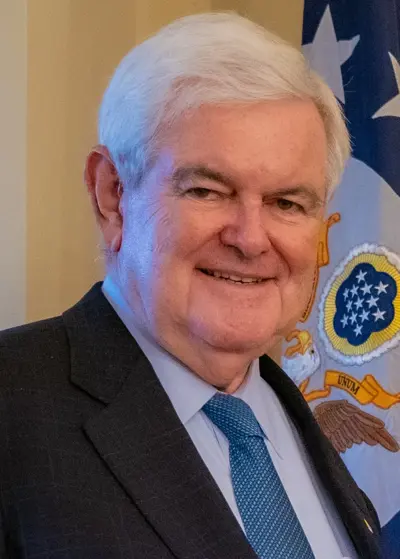
Newton Leroy Gingrich is an American politician and author who served as the 50th Speaker of the United States House of Representatives from 1995 to 1999. A member of the Republican Party, he was the U.S. Representative for Georgia's 6th congressional district serving north Atlanta and nearby areas from 1979 until his resignation in 1999. In 2012, Gingrich unsuccessfully ran for the Republican nomination for President of the United States.
