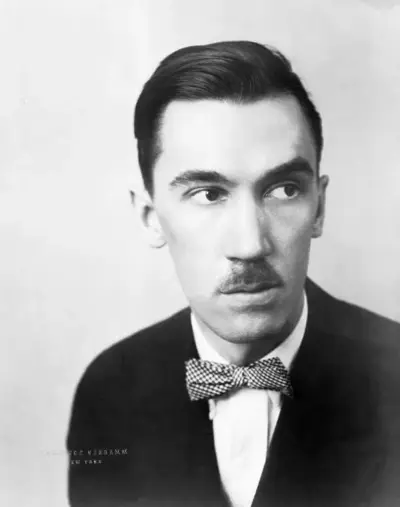
Robert E. Sherwood Quotes
This country is already, in effect, an arsenal for the democratic Allies
This was the earliest version of a variant of the great WWII propaganda phrase, “Arsenal of Democracy”. See --{624746} and {624747} for quotations related to this famous phrase.
Robert E. Sherwood, 1896–195, Playwright & Editor of Life Magazine, Speech writer for President Franklin D. Roosevelt, Director of Overseas Operations, Office of War Information, New York Times, May 12, 1940
Sourced by: Eigen's Political and Historical Quotations
Monnet began to use the exact phrase in Mid 1940. He almost certainly had read Sherwood’s earlier, similar phrase {624748}. However so had Presidential Aid Harry Hopkins who thought that it would be a good phrase for President Roosevelt to use to “brand” the activity of the United States. So diplomatically, Monnet was asked not to use the phrase any more, and he acceded to the request. At the end of the year, in a famous radio address, FDR used the phrase {624747}, and it has been associated with him ever since.
This was the address where FDR used the “arsenal of democracy” phrase which became so famous. A similar phrase was used in May by Robert E. Sherwood--{624748}. Then Jean Monnet began to use the exact phrase in Mid 1940--{624746}. He almost certainly had read Sherwood’s earlier, similar phrase. However so had Presidential Aid Harry Hopkins who thought that it would be a good phrase for President Roosevelt to use to “brand” the activity of the United States. So diplomatically, Monnet was asked not to use the phrase any more, and he acceded to the request. At the end of the year, FDR gave his address with this quotation.
After Japan attacked Pearl Harbor, we declared war on Japan. Germany then declared war on the United States, and America was in the fight. But the earlier policy had been to provide weapons, food, and supplies.
The president had wanted to send large amounts of armament and other material to England—Lend Lease—to help stave off a German invasion. The leading military men argued against it. Conservative isolationists and Congress had prevented our own military from having enough supplies and equipment. Also the conclusion of the American military leadership of the time was that England was beyond help and would have to capitulate to Germany. Even with massive armaments they would not be able to defend themselves. Any arms that we might provide to England would then fall into German hands. Roosevelt then sent his civilian assistant, Harry Hopkins, to England to assess their ability to survive. Hopkins with no military experience told Roosevelt that with the arms and ammunition England would be able to forestall invasion. Roosevelt trusted Hopkins’ judgment and decided to arm England. Hopkins turned out to be exactly correct and the military leadership was wrong. See {642830}.
America, England, Germany and France Many Japanese leaders predicted war between the Great Powers while America and its European Allies did not see the danger as clearly. Shortly after 1936, Hitler began the Second World War. Japan was indeed prepared. Hiranuma became one of the Japanese extremists and after WWII was convicted of war crimes and given a life sentence.
“Arsenal of Democracy” is the famous FDR phrase whereby America was able to provide weapons for the other democracies to fight Fascism. At the time, the United States had the greatest manufacturing capability of the world. When Gingrich made this quotation, much manufacturing that had been done in America had moved offshore. However, one area that did not move offshore was military weapons manufacturing where the United States manufacturing capability was thriving but America was the largest arms manufacturer in the world and exported much of its weapons. This quotation is an example of a political technique called “conflation.” Gingrich took an area where there was legitimate concern about the nation’s loss of manufacturing and implied that the problem was affecting our military and defense capability as well which was not do at all. However, while most Americans knew of the manufacturing job loss, they did not know that the defense manufacturing was the strongest in the world. So they became even more alarmed at the problem of general manufacturing loss.
Later, he felt that the offense had become almost invincible. See {626741}. Tesla was one of the great American immigrant scientists. He found in America the kind of intellectual and operational freedom that did not exist in the rigid, monarch-controlled, Austro-Hungarian Empire. He developed patents and techniques that formed the technological bases of radio, telephone long distance, TV, cell phones, Wi Fi, just to name a few. Most important he was Thomas Edison’s great nemesis. Edison invented DC electric generators that could power factories or entire streets in a neighborhood. Tesler invented and developed AC electrical technology which could power entire cities and he could move electricity over long distances which Edison could not. Tesler was one of the first scientists to conceive of and try to implement “Big Science” where there were huge capital investments to develop machines and systems to do what had never been done before—philosophically like the CERN Hadron Collider. Tesler even convinced a large corporation to finance the construction of a massive building and tower so he could experiment with the wireless transmission of electricity. However, as the industrial democracies have learned, Big Science can only be funded by governments and it often takes sever working in consort to afford the huge investment that is required. In Tesler’s era, the federal and state governments did not fund scientific research so his work was not only technically ahead of his time but also conceptually. He anticipated most of the problems and need for a national power grid that was challenging America even at the beginning of the 21st century.
The Factory had been established by the State of Virginia in 1775 to make guns. America filled with armed Americans in the Colonial era was a myth. Early America was not a gun culture. Guns were expensive, needed maintenance, took too long to reload, and were not as effective for most purposes as other weapons like hatchets and knives. American Colonial war was mostly hand to hand combat with relatively little shooting. Less than one fourth of the men joining Washington’s army owned guns. Gun factories could not survive for want of customers and gunsmiths went into other occupations. See {613052}. With the rebellion, it was critical to manufacture guns to arm the soldiers who had not their own. But the efforts like this were relatively feeble. The factory director who made not a single gun in over a year was then promoted to Commissary General of Munitions in the Continental Army. He was married to George Washington’s sister. He did however finance much of the munitions he procured with his own personal funds so made up in wealth and patriotism what he lacked in manufacturing skill.
1st Earl Mountbatten of Burma
Note that he assumes that not only will there be another World War, but he assumes that we will be on opposite sides.
We face that situation now. Tesla was one of the great American immigrant scientists. He found in America the kind of intellectual and operational freedom that did not exist in the rigid, monarch-controlled, Austro-Hungarian Empire. He developed patents and techniques that formed the technological bases of radio, telephone long distance, TV, cell phones, Wi Fi, just to name a few. Most important he was Thomas Edison’s great nemesis. Edison invented DC electric generators that could power factories or entire streets in a neighborhood. Tesler invented and developed AC electrical technology which could power entire cities and he could move electricity over long distances which Edison could not. Tesler was one of the first scientists to conceive of and try to implement “Big Science” where there were huge capital investments to develop machines and systems to do what had never been done before—philosophically like the CERN Hadron Collider. Tesler even convinced a large corporation to finance the construction of a massive building and tower so he could experiment with the wireless transmission of electricity. However, as the industrial democracies have learned, Big Science can only be funded by governments and it often takes sever working in consort to afford the huge investment that is required. In Tesler’s era, the federal and state governments did not fund scientific research so his work was not only technically ahead of his time but also conceptually. He anticipated most of the problems and need for a national power grid that was challenging America even at the beginning of the 21st century.
The most important weapons of the time involved gunpowder or other explosives, and the chemist was the most important weapons maker until the middle of the 20th century when a weapons system was first designed that did not use chemical explosives—nuclear weapons. Then the physicists became predominant.
He wrote this essay anonymously and signed it as “A Lover Of Peace”
1st Baron Verulam. The word “estate’ meant a political unit or subunit. These might be ruled by kings, dukes, war lords, etc. However, Bacon’s point was all armaments and the physical trappings of war are relatively minor when compared to the qualities of the population. With modern technology, this principle has become less and less true. Given the same technology in war, the outcome will depend on the human qualities and warlike disposition of the humans. However, a modern force with modern equipment and weapons can defeat an enemy of braver and more warlike disposition which does not have the same technology. In the modern world, a number of cultures find this a very distressing reality. The noble and courageous man should win, but Western technology, many complain, is undermining the old, traditional virtues.
- Born: April 4, 1896
- Died: November 14, 1955
- Nationality: American
- Profession: Author, Playwright, Screenwriter Historian