Herman Kahn Quotes
World War I broke out largely because of an arms race, and World War II because of the lack of an arms race.
Kahn, Herman. Thinking About the Unthinkable in the 1980s. Simon and Schuster, 1984, p. 118.


America, England, Germany and France Many Japanese leaders predicted war between the Great Powers while America and its European Allies did not see the danger as clearly. Shortly after 1936, Hitler began the Second World War. Japan was indeed prepared. Hiranuma became one of the Japanese extremists and after WWII was convicted of war crimes and given a life sentence.

The Times regretted that the Germans did not speak to the Austrians more vigorously when they were threatening to attack Serbia who harbored anti-Austro-Hungarian terrorists (see {642085}). What the Times editors did not realize was that the Germans had already made their war plans (see {642092}) and the Serbian issue was just the justification they needed to implement them. So there was no real reason for the Germans to discourage the Austro-Hungarian Empire from its mission to punish Serbia.


See the American ambassador’s assessment after the war began {41089}

Peruvian Revolutionary Group. This speech was made from prison.

Note that he assumes that not only will there be another World War, but he assumes that we will be on opposite sides.

stating that war was obsolete See {640087} for the quotation of exactly what Angell wrote.

Germany had just attacked Russia with whom it had a treaty. For a while, Hitler paid little attention to Italy and just gave their “ally” orders and instructions. Italian public opinion was concerned about the same question. See {627973} .

1914 was the outbreak of WWI in which all the belligerents had very different interests and reasons for war—even allies on the same side greatly differed as to their motivation for fighting.


This was very much a minority opinion at the time, and has much historical significance as he was the father of the British Prime Minister, Neville Chamberlain, 1869-1940, whose appeasement of Germany led to Word War II. . See {585941}.


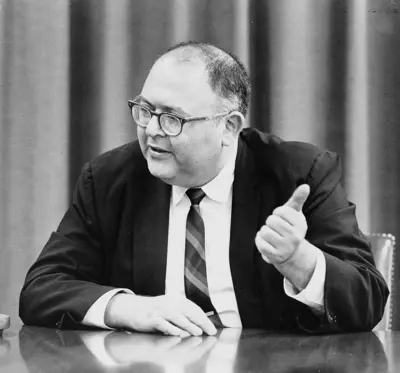
Herman Kahn was a founder of the Hudson Institute and one of the preeminent futurists of the latter part of the twentieth century. He originally came to prominence as a military strategist and systems theorist while employed at the RAND Corporation. He became known for analyzing the likely consequences of nuclear war and recommending ways to improve survivability, making him one of the historical inspirations for the title character of Stanley Kubrick's classic black comedy film satire Dr. Strangelove.
