Andrew Carnegie Quotes
While the law [of competition] may be sometimes hard for the individual, it is best for the race, because it insures the survival of the fittest in every department. We accept and welcome, therefore, as conditions to which we must accommodate ourselves, great inequality of environment, the concentration of business, industrial and commercial, in the hands of a few, and the law of competition between these, as being not only beneficial, but essential for the future progress of the race.
Most defenders of the Capitalist system that produces large inequities argue that interfering in the free market wouldl be worse. However this thesis argues that the inequality is actually good for the people including those at the low end of the ladder.
Andrew Carnegie, 1835-1919, Industrialist and Philanthropist, Wealth, 1899
Sourced by: Eigen's Political and Historical Quotations


Most companies in a capitalistic system compete mightily to obtain monopolistic positions so they can avoid capitalistic competition thereafter.


He was the judge who presided over the breakup of AT&T in 1984


In 1881 this view was that of a radical political outlier. In the first decades of the 21st century, this was a generally acceptable political viewpoint held by members of both major political parties.


Over a century ago writers were beginning to see the downside of a global economy. They had not however seen the enormous benefits against which the cost must be weighed.

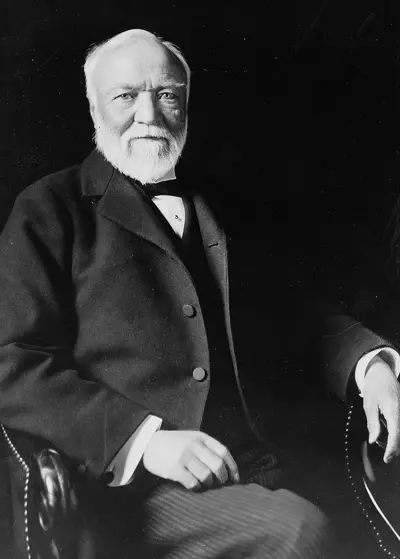
Andrew Carnegie was a Scottish-American industrialist and philanthropist. Carnegie led the expansion of the American steel industry in the late 19th century and became one of the richest Americans in history. He became a leading philanthropist in the United States and in the British Empire. During the last 18 years of his life, he gave away ~$350 million (roughly $5.2 billion in 2019) to many charities, foundations, and universities – almost 90 percent of his fortune. His 1889 article proclaiming "The Gospel of Wealth" called on the rich to use their wealth to improve society and stimulated a wave of philanthropy.
