Andrew Carnegie Quotes
The price which society pays for the law of competition is also great; but the advantages of the law are greater still.
Andrew Carnegie, 1835-1919, Industrialist and Philanthropist, Quoted in John B. Judis, “Are We All Progressives Now,” The American Prospect, May 8, 2000
Sourced by: Eigen's Political and Historical Quotations


Most companies in a capitalistic system compete mightily to obtain monopolistic positions so they can avoid capitalistic competition thereafter.


Most defenders of the Capitalist system that produces large inequities argue that interfering in the free market wouldl be worse. However this thesis argues that the inequality is actually good for the people including those at the low end of the ladder.


To the modern reader utterances such as this from a Conservative Prime Minister seem astounding. However, the Great Depression existed in Canada as well as the United States, and Franklin Delano Roosevelt was not the only world leader who would reach the conclusion that business and capitalism must be profoundly regulated and the system changed if it was to be saved.


In the late 19th century, the Sherman Antitrust Act was passed to control vicious monopolies and trusts. There were many who thought that this would be philosophically incompatible with the doctrine of free enterprise. James observed that the American philosophy required the testing of each doctrine and in the case of monopolies, the results were destructive for consumers, competitors, and society in general, with the monopolist the only beneficiary of the free enterprise where consumers and competitors lose their freedom.


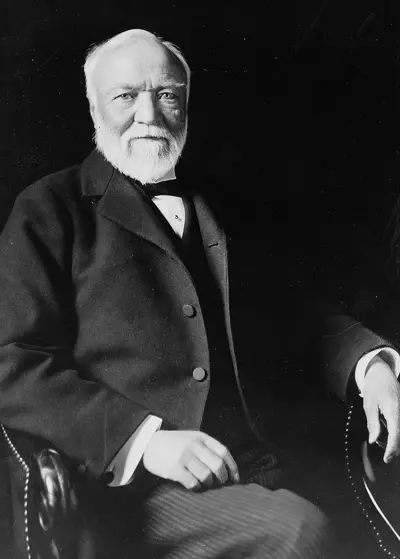
Andrew Carnegie was a Scottish-American industrialist and philanthropist. Carnegie led the expansion of the American steel industry in the late 19th century and became one of the richest Americans in history. He became a leading philanthropist in the United States and in the British Empire. During the last 18 years of his life, he gave away ~$350 million (roughly $5.2 billion in 2019) to many charities, foundations, and universities – almost 90 percent of his fortune. His 1889 article proclaiming "The Gospel of Wealth" called on the rich to use their wealth to improve society and stimulated a wave of philanthropy.
