Ann Coulter Quotes
While the form of treachery varies slightly from case to case, liberals always manage to take the position that most undermines American security.
Coulter, Ann. Treason: Liberal Treachery from the Cold War to the War on Terrorism. Crown Forum, 2003, p. 11.


In 1904, candidate Theodore Roosevelt solicited campaign funds from leading businessmen. After he was elected, he was viewed to have "turned" on them since he attempted to curtail monopolistic excess, instituted regulation, and made other business reforms. This is the original remark, but another, more sanitized version appeared in New York Times and other places as: “We bought him and he did not stay bought.”

Before the 1968 election, President Johnson, and gotten the North Vietnam Communists to agree to Peace Talks with the U. S. and South Vietnam. Then Candidate Nixon thought that if the peace talks were ongoing and making progress, there would be more support for the Democrats and Nixon's opponent Hubert Humphrey. So Nixon secretly send a secret emissary to South Vietnamese President Nguyen Van Thieu telling him that he would not get a very good deal because President Nixon claimed that President Johnson was too eager to end the Vietnam war. He suggested that if Thieu boycotted the peace talks, then when Nixon was elected, he would guarantee a much better deal for South Vietnam and Thieu personally. President Thieu boycotted the peace talks and there could be no progress. However there is a Federal Law, the Logan Act, that makes it a felony for a private American citizen to conduct or interfere with foreign policy or negotiations with a foreign government. President Johnson found out about Nixon—s sabotage of the Peace Talks, called Nixon and threatened him with prosecution if he interfered further. LBJ had decided that with the left wing at odds with the U. S. Government over the Vietnam War, a prosecution of Nixon would cause the Right Wing to challenge the government also and the country didn—t need further polarization. He would do that only if Nixon did not heed the President—s warning. But when Nixon won the election and became President, he was terribly anxious that his pre-election crimes would be made public, and spent much of his time and staff effort trying to find out who knew about his politically self-serving felony and who might make his crime public. See {583264}.


Arnold was not just any senior officer, but one who had been a great fighter against the British not only, leading his men brilliantly but exposed himself to great danger in the process. He had been such a hero that Washington could not imagine how an officer like that could become a traitor to the cause. Arnold’s treasom had nothing to do with ideology or the issues of the war. Arnold felt that he had not been appreciated for his efforts (his commanding officer gave him no credit for the most heroic and effective military battlefield leadership up to that point in the war) and became disaffected.

NASA was trying to avoid embarrassment and obfuscated a great deal of the information around the Challenger disaster. The NASA Administration established a technical scientific staff to do the technical investigation and report to the commissioners. However Feynman, a great scientist and mathematician, did his own analyses and calculations and even data collection and discovered that his results did bot comport with that of NASA or the commission staff which generally accepted the NASA data and analysis. It turned out that Feynman was right and he was able to expose the truth that NASA management had been responsible for the disaster for not paying attention to the data and recommendations to postpone the launch that existed.


Bush had served earlier as the head of the CIA and understood the costs of such better than most. He was put in a difficult position when his son was President and one of the senior White House operatives, for small partisan advantage, leaked the name and identity of Valerie Plame, a covert CIA operative. Bush the father, remained silent even after the leaker was identified.


He held up tools made by the Stanley Tool Company which had announced that they were relocating to Bermuda to avoid paying American taxes. The company changed its mind after this sort of publicity.

Harrison, then a young Captain, was concerned about the French, British and Spanish agents "plotting" in the United States:

McCarthy was one of the most interesting political phenomena of politics in the 1950s. He was an alcoholic megalomaniac who made wild accusations about communists everywhere and that the Secretary of State and other politicians were communists. He claimed to have a list of thousands of communists in high positions of government. His accusations were so dramatic that most people assumed that there were facts behind them otherwise no rational man would say such things. But it turned out that not a single accusation was ever proven. When McCarthy was esposed, he was censured by the Senate and he lost most of his political credibility and shortly thereafter died as a result of his severe alcoholism.


This was his name for the wealthy slaveowners in Tennessee. He was the military governor of Tennessee when he so labeled the secessionists.


Roosevelt was totally wrong on this. The explosion of the Maine which started the Spanish American War was later proved to be an accident,
George W. Bush. The leak was a felony to which the elder Bush was particularly sensitive as he had served as the CIA Director. The younger Bush did not take aggressive measures to find out which of his staff had provided the unauthorized and classified information to the press.
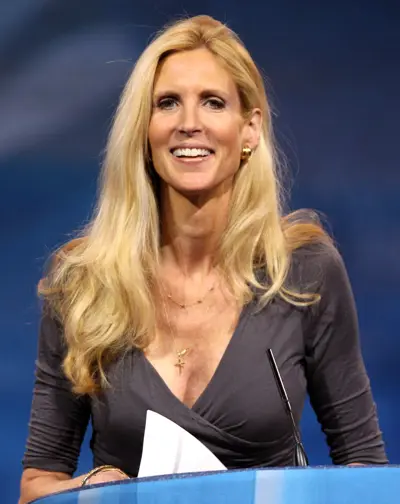
Ann Hart Coulter is an American conservative media pundit, best-selling author, syndicated columnist, and lawyer.
