Theodore Roosevelt Quotes
The Maine was sunk by an act of dirty treachery on the part of Spain.
Roosevelt was totally wrong on this. The explosion of the Maine which started the Spanish American War was later proved to be an accident,
Theodore Roosevelt, 1858-1919, 26th President of the United States (Republican, NY), Quoted in Williams, The Story of Spain
Sourced by: Eigen's Political and Historical Quotations


Before the 1968 election, President Johnson, and gotten the North Vietnam Communists to agree to Peace Talks with the U. S. and South Vietnam. Then Candidate Nixon thought that if the peace talks were ongoing and making progress, there would be more support for the Democrats and Nixon's opponent Hubert Humphrey. So Nixon secretly send a secret emissary to South Vietnamese President Nguyen Van Thieu telling him that he would not get a very good deal because President Nixon claimed that President Johnson was too eager to end the Vietnam war. He suggested that if Thieu boycotted the peace talks, then when Nixon was elected, he would guarantee a much better deal for South Vietnam and Thieu personally. President Thieu boycotted the peace talks and there could be no progress. However there is a Federal Law, the Logan Act, that makes it a felony for a private American citizen to conduct or interfere with foreign policy or negotiations with a foreign government. President Johnson found out about Nixon—s sabotage of the Peace Talks, called Nixon and threatened him with prosecution if he interfered further. LBJ had decided that with the left wing at odds with the U. S. Government over the Vietnam War, a prosecution of Nixon would cause the Right Wing to challenge the government also and the country didn—t need further polarization. He would do that only if Nixon did not heed the President—s warning. But when Nixon won the election and became President, he was terribly anxious that his pre-election crimes would be made public, and spent much of his time and staff effort trying to find out who knew about his politically self-serving felony and who might make his crime public. See {583264}.


George W. Bush. The leak was a felony to which the elder Bush was particularly sensitive as he had served as the CIA Director. The younger Bush did not take aggressive measures to find out which of his staff had provided the unauthorized and classified information to the press.

Haldeman had actually called the network executives on several occasions regarding Cavett’s show. Nixon was particularly furious when Cavett interviewed John Kerry, the decorated soldier who had thrown his medals away in protest to the handling of the Vietnam War. Nixon wanted some stronger actions taken.


McCarthy was one of the most interesting political phenomena of politics in the 1950s. He was an alcoholic megalomaniac who made wild accusations about communists everywhere and that the Secretary of State and other politicians were communists. He claimed to have a list of thousands of communists in high positions of government. His accusations were so dramatic that most people assumed that there were facts behind them otherwise no rational man would say such things. But it turned out that not a single accusation was ever proven. When McCarthy was esposed, he was censured by the Senate and he lost most of his political credibility and shortly thereafter died as a result of his severe alcoholism.

The 6 Day War began less then 6 months later. This was another failure of U. S. Intelligence. Essentially, Rusk and others took the belligerent speeches of Nasser and other Arab leaders as rhetoric meant only for local consumption and did not realize that the Arabs had so deluded themselves that they thought that they could really destroy the state of Israel. American intelligence assumed that they knew better and their threats were just traditional Arab exaggeration and boasting.

Harrison, then a young Captain, was concerned about the French, British and Spanish agents "plotting" in the United States:

He was shot in 1944 for his involvement in an attempt to kill Hitler
Bush had served earlier as the head of the CIA and understood the costs of such better than most. He was put in a difficult position when his son was President and one of the senior White House operatives, for small partisan advantage, leaked the name and identity of Valerie Plame, a covert CIA operative. Bush the father, remained silent even after the leaker was identified.


Ford assumed the Presidency upon Nixon’s Watergate resignation. He was the only President in history who had never been elected to national office. When he pardoned Nixon he lost much of his support from the left and the middle. Weakened, he came under the influence of the very conservative wing of the Republican Party who urged him to dump his Vice President Nelson Rockefeller from the Republican ticket in the 1976 election. Rockefeller was a liberal republican who supported abortion rights and civil rights. Rockefeller, realizing that Ford’s nomination was in danger, volunteered to step down. {641394} Ford accepted and regretted his action as soon as he had done it. The result was that Ford lost to a relatively unknown Southern governor, Jimmy Carter. However the Conservative wing of the Republican Party had triumphed and the liberal republicans, who had been the backbone of the Republican Party since its inception did not play a significant role in the party for the next 30 years.


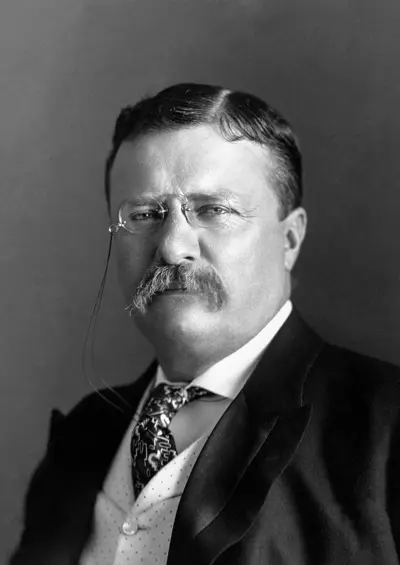
Theodore Roosevelt Jr., often referred to as Teddy or his initials T. R., was an American statesman, conservationist, naturalist, historian, and writer, who served as the 26th president of the United States from 1901 to 1909. He previously served as 33rd governor of New York from 1899 to 1900 and the 25th vice president of the United States from March to September 1901. Roosevelt emerged as a leader of the Republican Party and became a driving force for anti-trust and Progressive policies.
