Sushma Swaraj Quotes
Why did the Pakistani military attack us on behalf of JeM? You not only keep JeM on your soil but fund them, and when the victim country retaliates, you attack it on the terror outfit's behalf.
Swaraj, Sushma. "Speech at BJP Women's Wing Event." The Indian Express, 16 Apr. 2019.


This is diplomatic language for a very stern warning. Pakistan supported terrorist organizations because 1) they used the terrorists as their proxies in their continuing conflict with India. The terrorists were a de facto asset of the Pakistani Intelligence Service. 2) Many Pakistani citizens were ultra-orthodox Muslims and believed in the religious objectives of the terrorists and even shared a religious belief in the propriety of the terrorist methods as long as they were being applied to non-Muslims or Muslim heretics. 3) Much of the militant infrastructure was in the tribal, frontier areas of the country where the government was relatively weak. 4) The militants had taken the position that if the Pakistan government tried to curtail their jihad efforts, then the government and its supports were heretical Muslims and were, under Sharia—Islamic Law—proper targets for their terrorism activities. The number of Pakistani Muslims that the terrorists murdered was far greater ironically than the American or European Christians and Indian Hindus that had been killed. A decade later, the Pakistani authorities were split over those who realized that the terrorists were most dangerous to the Pakistanis themselves—and especially the government officials—and those who believed that the terrorists should have continued support because of the 4 reasons above.
Azad Kashmir is that part of the disputed territory of Kashmir that was under Pakistan’s control, as opposed to the part of Kashmir that was under Indian Control.


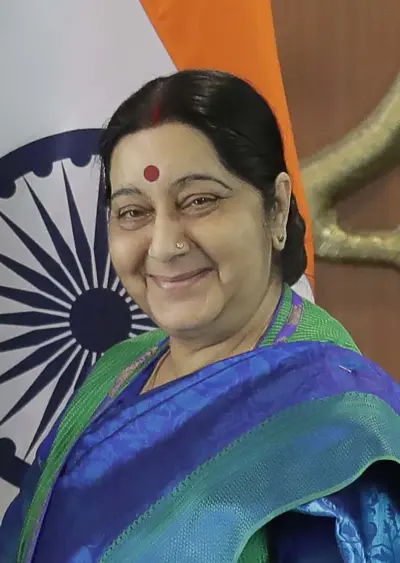
Sushma Swaraj (pronunciation (help·info)) was an Indian politician and a Supreme Court lawyer. A senior leader of Bharatiya Janata Party, Swaraj served as the Minister of External Affairs of India in the first Narendra Modi government (2014–2019). She was the second woman to hold the office, after Indira Gandhi. She was elected seven times as a Member of Parliament and three times as a Member of the Legislative Assembly. At the age of 25 in 1977, she became the youngest cabinet minister of Indian state of Haryana. She also served as 5th Chief Minister of Delhi for a short duration in 1998 and became the First female Chief Minister of Delhi.
