Peter Singer Quotes
Whereas the property-owning middle class could win freedom for themselves on the basis of rights to property--thus excluding others from the freedom they gain--the property-less working class possess nothing but their title as human beings. Thus they can liberate themselves only by liberating all humanity.
Singer, Peter. Marx: A Very Short Introduction. Oxford University Press, 2000, p. 26.


In 1877 Wasburn was dropped from the List of Ministers by the Unitarian Church. He had become quite atheistic.

This was written and adopted by Vermont a decade before the United States Constitution the ideas for which were in existence in America before the Constitutional Convention in Philadelphia.


The intentions of the Founding Fathers towards the Indians was decent, respectful, and well intentioned. However, there was not enough of a system of enforcement or the will to enforce when the greed of the average whites grew too great. Many settlers saw these vast lands and could not see any harm in using a few acres for their farm. And if there had been only a few, there would have been little trouble. However, the settlers kept coming and coming and soon the Indians began to push back. In a sense, it was a class problem. The members of the Continental Congress who wrote the Northwest Ordinance were educated, affluent men who had plenty of land. Most of the men who contested for the Indian lands had little land or were newly affluent and saw few limits to America.


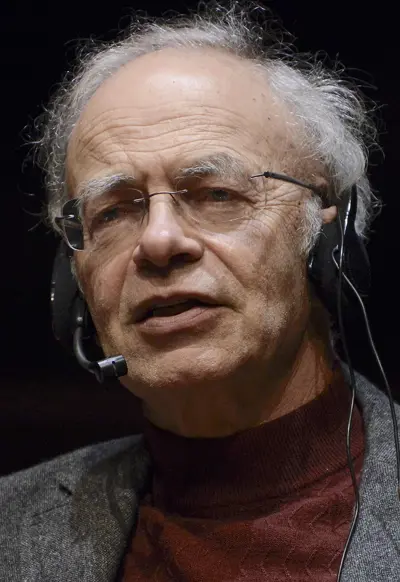
Peter Albert David Singer AC is an Australian moral philosopher, currently the Ira W. DeCamp Professor of Bioethics at Princeton University. He specialises in applied ethics and approaches ethical issues from a secular, utilitarian perspective. He is known in particular for his book Animal Liberation (1975), in which he argues in favour of veganism, and his essay "Famine, Affluence, and Morality", in which he argues in favour of donating to help the global poor. For most of his career, he was a preference utilitarian, but he stated in The Point of View of the Universe (2014), coauthored with Katarzyna de Lazari-Radek, that he had become a hedonistic utilitarian.
