Joseph Cannon Quotes
Whence comes this demand for tariff tinkering. Aren't all our fellows happy?
During Theodore Roosevelt's administration there was a movement for tariff reform. The Speaker advised against any change, and the President finally accepted his view:
Joseph Cannon, 1836-1926, U. S. Congressman (Republican, IL), Speaker of the House, Advice to party leaders, Quoted in The Washington Post, November 17, 1905
Sourced by: Eigen's Political and Historical Quotations


The issue of free trade has been controversial during the entire history of our Republic. At the time it was the Republicans who were the protectionists and the Democrats, the free traders.

A self-contained market would be one in which a country only makes products that it sells within its borders, and only sells products that in makes in the country. Very primitive cultures were self-contained markets, but trading generally takes place whenever two cultures interact unless politicians artificially prevent it.

This summary of the problem of trying to politically “sell” free trade is as good as anyone has ever said it in America. And the problem and argument has not changed since. Free trade is good for most, but really harms some in specific situations. The beneficiaries often do not realize who they are or how they have benefitted, but those who are harmed generally know exactly how and what the damages are.


Whitaker was right bet at that time his advice was not heeded. When Ireland late in the 20th century finally acted on his advice and eliminated almost all of their protectionism, the economy thrived and not only did the Irish emigration stop, but people began to immigrate to Ireland for the economic opportunity.


Democratic politicians of that era mostly opposed free trade because the experience ever since NAFTA showed that many manufacturing jobs were lost in the United States although many new jobs were created but few of these were good paying jobs that Americans with limited educations could perform as they were able to with manufacturing jobs. And during that period, the requirements for fair trade and foreign workers rights have been very poorly enforced. The Democrats split between those who thought that new trade treaties could be negotiated and enforced, correcting the problems of the past, and those who did not believe that such proper free trade was very likely.


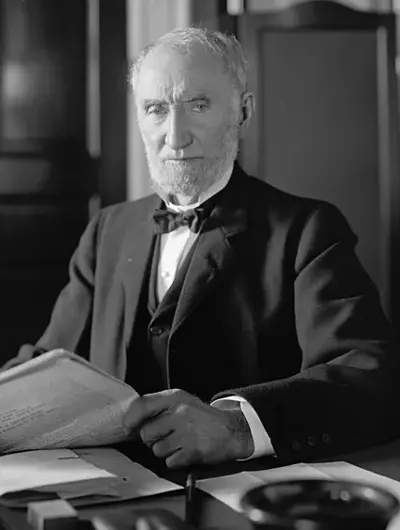
Joseph Gurney Cannon was a United States politician from Illinois and leader of the Republican Party. Cannon served as Speaker of the United States House of Representatives from 1903 to 1911, and many consider him to be the most dominant Speaker in United States history, with such control over the House that he could often control debate. The Cannon House Office Building, the oldest congressional office building, completed in 1908, was named for him in 1962.
