John Dewey Quotes
When we consider the close connection between science and industrial development on the one hand, and between literary and aesthetic cultivation and an aristocratic social organization on the other, we get light on the opposition between technical scientific studies and refining literary studies. We have before us the need of overcoming this separation in education if society is to be truly democratic.
John Dewey, 1859-1952, Philosopher & Educator, Democracy and Education, 1916
Sourced by: Eigen's Political and Historical Quotations

When Tocqueville studied the United States, it was inferior to the England and the other European aristocracies in science, the arts, literature, philosophy, theology and most other intellectual fields of culture and human endeavor. He did not have the opportunity to observe the interactive, long term effects of freedom, democracy, and public education. The US would become the dominant cultural nation of the world, with the English language in far greater usage than at the height of the British Empire. American Science, literature, art developed with more and more people participating in and being educated for those areas and were free to create without the restraints of government or even cultural norms. American creativity was demonstrated by more new religions being created that than in any other nation on earth.


First Muslim to win the Nobel Prize


Access not being free did not refer to tuition, but to the concept of free competition. At the time West Point and Annapolis did not admit students on the basis of meeting any educational preparation or test criteria. A student had to have a political patron for admission. As a result, most colleges and university faculty would have little to do with the service academies and whereas most other schools were making major changes to teach the rapidly changing sciences that were growing, few would interact with the academies. It was during this period that the service academies fell behind academically and never did catch up. Even today a student must be nominated by a politician—usually a Senator of Congressperson. At least today, the applicant must pass reasonable qualification examinations and have a strong high school record. Back in 1869 it was pure politics and Eliot and other Academics saw the schools as extensions of corrupt patronage politics as many student’s families bribed politicians for their sponsorship.

He raised an intellectual alarm that scientists were generally ignorant of the liberal arts and non-scientists were scientifically illiterate. This was not good for society where both were needed for making public policy and developing our society. He was quite influential in British and American higher education where many colleges added required science courses to liberal arts curricula and vica versa. However by the 21st century, the sciences had advanced at such a rapid pace, that the taking of a few college level science courses was not sufficient to produce a scientific literacy, and the problem was no better than in the 1950s.


Adams let the drafting team.


The societies that had regularly produced the great advances in the sciences were those that allowed its citizens much liberty—liberty of thought, expression, association, etc. Where religious dogma controlled thought and expression, great scientific achievements were far less probable or less productive. Imagine, what Galileo might have achieved if the Church had not curtailed his efforts. When Islamic society was open, the sciences flourished whereas they were stifled in Christian Europe, but once Islam closed and liberty was no more, Islamic science degenerated to its low point of the 21st century.
Jefferson had been opposed to manufacturing—see {606441} for his view 27 years earlier.
In Jefferson’s time most people aspired to acquire some land, and have their own home and farm on it. Immigrants come to the cities and worked to make enough money to go somewhere else and acquire some land to create a farm. However, over the last 100 years, the economy and human aspirations have changed. People are leaving the land and the farms to look for non-agricultural work and cities are expanding all over the world while rural area populations are declining. While undeveloped societies still have land reform pressure, industrial democracies have little pressure for individual ownership of land except to place a home on. Acreage for farming and ranching is no longer desirable for most people. In the United States, there are millions of acres of undeveloped land that can be purchased very cheaply as few people want to start farms or ranches any more. Alexander Hamilton’s vision of the American Economy has come to pass and not Jefferson’s.


His hope that the elite intelligentsia would lead the nation was thwarted by Islamic fundamentalism which destroyed most of Pakistan education by only teaching religion in its Madrassas and not allowing the leadership to have compulsory education. There has been an enormous brain drain with a huge number of the Pakistani intelligentsia on which Jinnah pinned his hopes, had no opportunity in Pakistan and emigrated to the United Kingdom and America.

By “arts” Jefferson meant the mechanical arts—inventions and engineering. Jefferson Extrapolated the science and technology progress at the time to the future in a way that few others did at that time.
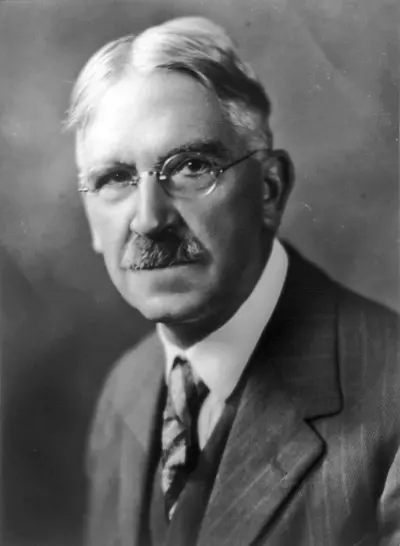
John Dewey was an American philosopher, psychologist, and educational reformer whose ideas have been influential in education and social reform. He was one of the most prominent American scholars in the first half of the twentieth century.
