Sun Yat-sen Quotes
When the war was in progress, England and France agreed wholeheartedly with the Fourteen Points. As soon as the war was won, England, France, and Italy tried to frustrate Wilson's program because it was in conflict with their imperialist policies. As a consequence, the Peace Treaty was one of the most unequal treaties ever negotiated in history.
Sun, Yat-sen. San Min Chu I: The Three Principles of the People. Translated by Frank W. Price, Commercial Press, 1927, p. 86.


Nicolson was an eyewitness to the proceedings.

Germany had just attacked Russia with whom it had a treaty. For a while, Hitler paid little attention to Italy and just gave their “ally” orders and instructions. Italian public opinion was concerned about the same question. See {627973} .


This illustrates one of the reasons that the Israeli Arab conflict has been unsolvable over the years. A thousand years ago, the Arabs were a leading intellectual and military power in the world. The rest of the world has moved ahead and they have actually retrogressed. So the Arabs seek dignity which is very elusive. They have never wanted to negotiate terms with Israel when they have been weak and feel defeated. So the pattern has been that they feel they cannot negotiate for justice as they are too week. So periodically they attack Israel which has always defeated them and hoped that after the Arab defeat, permanent negotiations for peace could take place. But the Arabs were feeling too weak. So they just repeated all their extreme demands. After a few years, they would try another attack, lose again and the cycle would repeat. The Israelis fear that if the Arabs every won a war, the Arab moderates might be willing to reasonably negotiate, the extremists would want to continue the fighting and “drive the Israelis into the sea” as they have so often threatened.

The Germans pretended to maintain the treaty and when the French totally evacuated the Rhineland, Hitler started his preparation for WWII and a little later invaded France. Clemenceau had been snookered.
since the end of WWI The railroads were nationalized for WWI and he ran them all as a government official


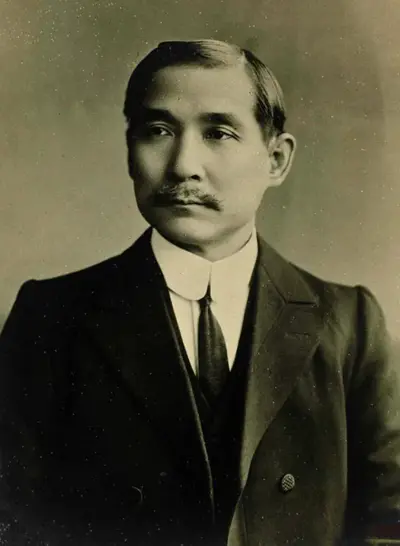
Sun Yat-sen was a Chinese statesman, physician, and political philosopher, who served as the provisional first president of the Republic of China and the first leader of the Kuomintang (Nationalist Party of China). He is referred as the "Father of the Nation" in the Republic of China, and as the "Forerunner of the Revolution" in the People's Republic of China for his instrumental role in the overthrow of the Qing dynasty during the Xinhai Revolution. Sun is unique among 20th-century Chinese leaders for being widely revered in both mainland China and Taiwan.
