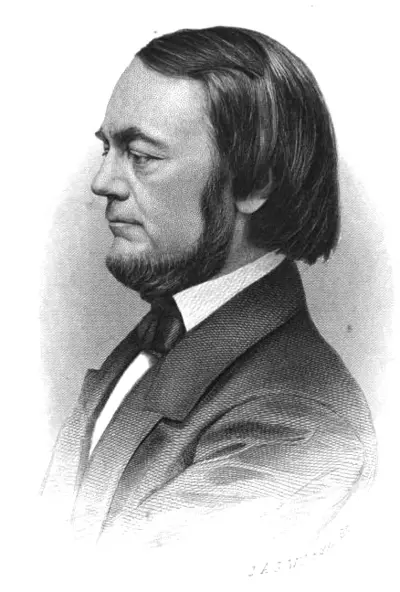
Edwin Percy Whipple Quotes
When the public mind first took its bent towards science, I, for one, foresaw that the Devil would soon be to pay with our cherished ideas. Under the plea of exercising some of the highest faculties of human nature, these scientific descendentalists have exclusively devoted themselves to the lowest objects of human concern…. There isn't a statesman, or philanthropist, or poet, or hero, or saint in the land, sir, that they would condescend to look at, when engaged in exploring the remains of some ignorant ass of the Stone Period.
This humorous essay was written less than a decade after Darwin published his first treatise on evolution. Here a witty American essayist and critic is giving an insight into the thoughts of the many people who either were scandalized by the concept of human evolution or honestly could not grasp such a new intellectual set of concepts. Many of the great scientific intellectual breakthroughs spread with stunning rapidly—usually amongst scientists, but in the case of evolution to most intellectuals and men of letters, they could use Darwin’s framework and observe evidence of evolution all over. So here, less than 10 years from the inception of evolutionary theory among English scientist, we have American non-scientific literati reading articles in the general (albeit sophisticated) Atlantic Monthly with a semi-serious, semi-comical, analysis of the thinking of people who resisted what had become in just a few years obvious truth to America’s leading intellectuals (except for most of the leading intellectual theologians who would take longer to accept evolution, but, with the exception of the extreme fundamentalists, most did.
Edwin Percy Whipple, 1819-1886, Essayist & Critic, “Mr. Hardhack on the Derivation of Man from the Monkey”, The Atlantic Monthly, March 1867
Sourced by: Eigen's Political and Historical Quotations


At the time, there were many people who were outraged and offended by the Evolutionary concept that man descended from “brute” animals. Cummings was one of the people who went public against those conservative elements of society who had so much difficulty with the Theory of Evolution.

The idea that man’s ancestors were so called “lower animal” was very upsetting to many people. They did not necessarily have a religious objection to the idea but felt diminished somehow. Broca was one of those who tried to provide a more positive perspective.


1st Earl of Beaconsfield. In this famous speech, Disraeli demonstrated his great political skill, by charming the scientists as well as the clerics regarding the then new concept of Darwinian evolution.
The “experts” were scientists and science educators who had testified that Creationism, a notion that some religious Christians believe is a more valid explanation of the development of plants and animals than is Evolution, is a religious belief, not a science and should not be taught in a science curriculum. McLeroy believed that even in teaching science, scientific thinking and expertise should not be given more weight than religion in general and Christianity in particular. Some fundamentalist Protestants find Evolution distressing in that it contradicts the literal Biblical narrative. Other Protestants, Jews, and Catholics do not see anything in Evolution that conflicts with their spiritual view of God. They see Evolution as the mechanism that God created for the development of life. McLeroy was defeated in the next election after taking this anti scientific position, and was replaced with another fundamentalist Protestant—but one who did not believe that a particular Protestent, Christian view of the world which scientists generally reject should be taught as science in public schools.

This is an important quotation for several reasons. First, it demonstrates the extreme diversity of religion in America. To Swaggart, Evolution is a “Satanic Theory”. However, to most American religious leaders, Evolution, per se, is not problematic. The Roman Catholic Church has no trouble with Evolution; Catholic Universities teach Evolution as a basic part of their science curricula. Jews have no theological problems with Evolution. None of the main-line Protestant Churches have any theological opposition to Evolution per se. Yet there are other Protestant denominations who find that Evolution is in contradiction to a literal interpretation of the Bible and hence do not accept it. Second, it shows the extreme level of vituperation and disrespect that is given differing points of view by some of the extreme fundamentalists who do not have the traditional American religious tolerance for differing belief structures. Here Swaggart accuses the hundreds of millions of Catholic, Protestant, Jewish, Buddhist and other clerics and laypeople who see Evolution as a well-established explanation of much of science, of being not only atheists but atheists in league with the Devil. A third factor is that this quotation is an example of a Minister telling people what is or is not science and scientifically demonstrated. If a scientist without any religious training of study were ever to render judgments on theology, most of us would laugh and see it as ridiculous. However when a cleric like Swaggert, untutored and ignorant of even basic science, makes scientific pronouncements, he (and many other fundamentalists) find that reasonable.

Essentially, he was expressing a Darwinian idea in poetry. See Herbert Spencer {627582} for an even more specific argument for the same point.

This was not only the case in 1852, but also true 150 years later. The only difference is that there is much more proof of Evolution, and there is a much smaller proportion of the population that questions Evolution as the fundamental mechanism by which all species have developed.

See President Clinton’s quotation at the same press conference {628400}.

The “brother of the wolf” refers to the evolution of the dog from the wolf which it now appears took place in just a relatively few generations.

This is a wickedly funny exploration into the issue of democracy and science. This humorous essay was written less than a decade after Darwin published his first treatise on evolution. Here a witty American essayist and critic is giving an insight into the thoughts of the many people who either were scandalized by the concept of human evolution or honestly could not grasp such a new intellectual set of concepts. Many of the great scientific intellectual breakthroughs spread with stunning rapidly—usually amongst scientists, but in the case of evolution to most intellectuals and men of letters, they could use Darwin’s framework and observe evidence of evolution all over. So here, less than 10 years from the inception of evolutionary theory among English scientist, we have American non-scientific literati reading articles in the general (albeit sophisticated) Atlantic Monthly with a semi-serious, semi-comical, analysis of the thinking of people who resisted what had become in just a few years obvious truth to America’s leading intellectuals (except for most of the leading intellectual theologians who would take longer to accept evolution, but, with the exception of the extreme fundamentalists, most did.
This humorous essay was written less than a decade after Darwin published his first treatise on evolution. Here a witty American essayist and critic is giving an insight into the thoughts of the many people who either were scandalized by the concept of human evolution or honestly could not grasp such a new intellectual set of concepts. Many of the great scientific intellectual breakthroughs spread with stunning rapidly—usually amongst scientists, but in the case of evolution to most intellectuals and men of letters, they could use Darwin’s framework and observe evidence of evolution all over. So here, less than 10 years from the inception of evolutionary theory among English scientist, we have American non-scientific literati reading articles in the general (albeit sophisticated) Atlantic Monthly with a semi-serious, semi-comical, analysis of the thinking of people who resisted what had become in just a few years obvious truth to America’s leading intellectuals (except for most of the leading intellectual theologians who would take longer to accept evolution, but, with the exception of the extreme fundamentalists, most did.


Actually no school teaches that. What they did teach when covering Evolution was that some modern apes (chimpanzees and bonobos) and humans were both descended from a common ancestor. The Congressman was at that point an evangelical Christian fundamentalist, Later, DeLay was convicted and sentenced to jail for money laundering and illegally spending and raising campaign funds. He was also reprimanded by the House Ethics Committee for unethical methods of fund raising for other earlier actions.


Darwin initially did not use the phrase “survival of the fittest.” Herbert Spencer did in another context {627587}. With respect to evolution, some people mistakenly assume that this means that the strongest survive and the weak do not. But “fit” and “strong” are not synonymous. For example, the Lion is the strongest and top predator of the African Plain. An antelope, Thompson’s Gazelle, is tiny, not very fast, and has no defenses against the lions, cheetahs, leopards, hyenas, and wild dogs. He is the most eaten animal on the Plain. Yet this gazelle is growing in numbers and is thriving while the lions are becoming an endangered species. The Thompson’s gazelle are more fit for that environment because they breed so fast and at such a young age and have multiple babies. They are more fit than the lions because they breed more prolifically. Other animals are seemingly endangered in one environment (like beaver in the United States) but thrive in another (the Southern tip of Argentina)
These quotations taken from one of Martin’s books illustrate the extreme language and intensity of feeling that was engendered amongst some Christian Fundamentalists when Evolution began to be taught in high schools. Martin and like-minded fundamentalists truly believed that the youngster who attended classes in Evolution would burn in Hell eternally.