FRANCIS GALTON
(Sir Francis Galton)
There were some people at the time who believed that by means of effort and following moral precepts there would be an equality of achievement. There were also many who began to observe that much of the differences between individuals were are result of environment—opportunity for education, socialization and other factors. Science is still trying to determine the relative causal contributions to individual differences of genetics and environment.
This quotation is important for two reasons. First, it appears to be the first use of the nature-nurture words to discuss this concept. Second, this “conclusion” started one of the longest running scientific debates in biology—nurture vs nature.
This quote was the beginning of the now discredited Eugenics movement. The essential problems were twofold: One was that someone had to decide which characteristics were desirable and undesirable, and there is wide difference of opinion that there is no way of resolving. Genocide is the result of Eugenics taken to extremes. Second, it the issue of human rights. No person, organization, or government has the right to tell a particular individual what genetic characteristics he/she may have with his/her children. Note that the issue of Population Control for size was also a part of the early Eugenics movement but is a totally separate issue. It is the voluntary verses the compulsory nature of Population control the is the critical ethical element.
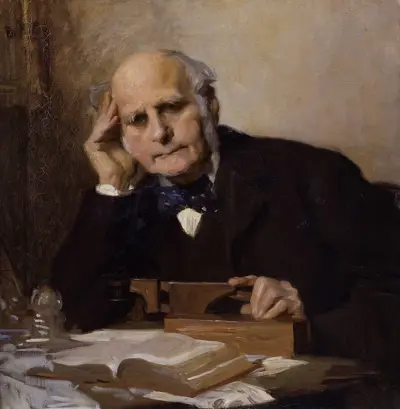
Sir Francis Galton, FRS, was an English Victorian era polymath: a statistician, sociologist, psychologist, anthropologist, tropical explorer, geographer, inventor, meteorologist, proto-geneticist, psychometrician and a proponent of social Darwinism, eugenics and scientific racism. He was knighted in 1909.
