Francis Galton Quotes
The aim of eugenics is to represent each class or sect by its best specimens; that done, to leave them to work out their common civilization in their own way.
Galton, Francis. "Eugenics: Its Definition, Scope, and Aims." The American Journal of Sociology, vol. 10, no. 1, 1904, p. 3.


This pseudo-scientific organization, in spite of the junk science it was promulgating, actually had a substantial American following and over 20 states actually passed laws to allow forced sterilization who were “UNFIT”. In reality while there is a genetic component to each of the examples it only increases the probabilities and is not determinative. And even f it were and there were selective breeding of humans, these “TRAITS” would not be eliminated in 3 generations,

There was a substantial movement to prevent mentally defective and people of low intelligence from being able to reproduce. Over 20 states, with the approval of the then Supreme Court performed forced state sterilizations. Of course the then definition of “degenerates” changed from state to state. A century later, American values changed so much that there is no state that would even consider involuntary sterilization and if they did, the Courts would hold it un-Constitutional.
The Eugenics Movement, which grew quite popular for a while, tried to improve the race of man, not by improving individual people or even a generation of people, but of selective and restrictive breeding of humans. The coercion and bias associated with it caused one of the worst violations of human rights in American History, and then was picked up by Adolf Hitler who carried the ideas to one of the worst atrocities in human history—the murder of “inferior races” so that they could not breed, thereby in their warped theory developing a super race.


This book was the first popular attempt to spread the eugenics concept. Is was translated into German in 1925 and unfortunately read by Adolf Hitler who sent Grant a complimentary letter. See {603544}

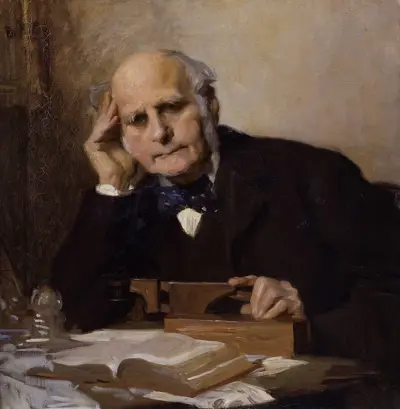
Sir Francis Galton, FRS, was an English Victorian era polymath: a statistician, sociologist, psychologist, anthropologist, tropical explorer, geographer, inventor, meteorologist, proto-geneticist, psychometrician and a proponent of social Darwinism, eugenics and scientific racism. He was knighted in 1909.
