Francis Galton Quotes
Man is gifted with pity and other kindly feelings; he has also the power of preventing many kinds of suffering. I conceive it to fall well within his province to replace Natural Selection by other processes that are more merciful and not less effective. This is precisely the aim of Eugenics. Its first object is to check the birth-rate of the Unfit, instead of allowing them to come into being, though doomed in large numbers to perish prematurely. The second object is the improvement of the race by furthering the productivity of the Fit by early marriages and healthful rearing of their children. Natural Selection rests upon excessive production and wholesale destruction; Eugenics on bringing no more individuals into the world than can be properly cared for, and those only of the best stock.
This quote was the beginning of the now discredited Eugenics movement. The essential problems were twofold: One was that someone had to decide which characteristics were desirable and undesirable, and there is wide difference of opinion that there is no way of resolving. Genocide is the result of Eugenics taken to extremes. Second, it the issue of human rights. No person, organization, or government has the right to tell a particular individual what genetic characteristics he/she may have with his/her children. Note that the issue of Population Control for size was also a part of the early Eugenics movement but is a totally separate issue. It is the voluntary verses the compulsory nature of Population control the is the critical ethical element.
Francis Galton, 1822-1911, English Scientist & Mathematician, Memories of My Life, 1908
Sourced by: Eigen's Political and Historical Quotations

The magnificent result of modern civilization has been to extend the average lifespan of humans by decades. What Galton called “weakly lives” are those that were eradicated by smallpox, bubonic plague, polio and hundreds of other diseases and risks where we have strengthened mankind and not simply succumbed to all the many natural dangers. At the same time however, civilization has added risks and dangers to human life. Automobile crashes, industrial accidents and the like. The balance has been well in favor of “civilization.”

Darwin believed at the time that large populations were critical to national success and development. The next 100 years would prove that large population was a handicap to progress and real growth of standard of living.

Darwin’s work had polarized England into two camps. Spencer was one of the major public supporters of Darwin. Tennyson expressed a similar intuitive view a decade earlier {627586}. Spencer reasoned that if an egg cell and a sperm cell could produce a human in 9 months, why was it not plausible that the cell could become a human in hunreds of millions of years.

Fisher, a brilliant scientist and mathematician, engaged in some major blunders like denying that tobacco had any relationship to lung cancer and other disease. This was another. His “conclusion” that the more “successful” members of society should breed in preference to the less successful. There are three major fallacies in his argument and that of other eugenics supporters other than the obvious ethical and moral problems. First, human success in any society is determined by both genetic and environmental factors. In general, it is currently impossible to know who the successful would be if environmental factors were equal. Second, our concept of success is quite narrow from an evolutionary point of view. The most successful humans might be those who produce that most children, or those who extend man’s habitat, or those who will be most resistant to a pandemic that will arise in the near future. Third, by the standards of much of English society at the time, the most “successful” people were the monarchy and heredity aristocracy, There was already too much inbreeding in these groups and increasing this groups breeding rather than others would not only weaken the species over time, but would limit the variation that is necessary for natural selection and further evolution of the human species.

What he thought was conceivable in the 1970’s seemed almost certain to come to pass 30 years later. Scientists had already altered the evolution of various plants and animals, and the complete human genome had been sequenced. The question will be not whether man will be able to control and modify his own evolution, but how should this be done and who should decide it. We have realized that man has already—unintentionally—altered the evolution of many species from passenger pigeons which are now extinct and the dog which coevolved with humans. Arguably, man’s development of the ability to control his own evolution is an evolutionary development itself. One great question for society is whether it is better to alter evolution unknowingly or in a planned, relatively controlled manner. For man to participate in the design of human evolution will be the nightmare of the Creationists who insist that evolution is too complicated to be somewhat of a random process and that there must be a designer who they assume is God. When man becomes the designer, that will be very disturbing. For most theologians, there will be little difficulty with the notion that God chose the mechanism of evolution and chose humans to give the intellect and knowledge to implement and design the evolutionary process.
Even today many people find Darwin’s views wanting because of the struggle and survival of the fittest concept implying that all creatures physically battle for survival and existance. But as this quotation illustrated, this was and is a very narrow view of Darwin’s concept of the struggle. Creatures fighting with each other is only a small part of this struggle. Larger parts are adapting to changed climate, versatility in food selection and extremely important a successful breeding pattern. The Thompson’s Gazelle is the most eaten animal on the African plains, and has virtually no defenses, but is an amazing breeder, with the shortest period of gestation of any mammal and the number of pregnancies per year. This little antelopes are thriving while they are eaten by most predators while the Lion, the strongest predator whom no animal will threaten, is becoming extinct.
This is the first use of the famous phrase—“survival of the fittest.” Spencer thought of it as a synonym for Darwin’s “natural selection”, but modern scientists do not use the phrase because it is circular reasoning. It is the fittest who survive it implies when whichever species survives is obviously fittest for that time and place. It is also misinterpreted as a predation scale war which it is not. The lion is much stronger than the antelopes and feeds on them, but the lions are dying out while the antelopes are thriving and developing. The fittest may be so because the species is a faster and more reliable breeder. Most people with a limited knowledge of evolution and scince associate the fittest with the top predator. However, over time, most top predators have NOT survived as well as many other species which in a predation fight are weak, but are more can handle a wider climate range, can change rapidly in response to natural disaters, can breed efficiently, are resistant to diseases, require less food, and literally thousands of other factors.

Darwin initially did not use the phrase “survival of the fittest.” Herbert Spencer did in another context {627587}. With respect to evolution, some people mistakenly assume that this means that the strongest survive and the weak do not. But “fit” and “strong” are not synonymous. For example, the Lion is the strongest and top predator of the African Plain. An antelope, Thompson’s Gazelle, is tiny, not very fast, and has no defenses against the lions, cheetahs, leopards, hyenas, and wild dogs. He is the most eaten animal on the Plain. Yet this gazelle is growing in numbers and is thriving while the lions are becoming an endangered species. The Thompson’s gazelle are more fit for that environment because they breed so fast and at such a young age and have multiple babies. They are more fit than the lions because they breed more prolifically. Other animals are seemingly endangered in one environment (like beaver in the United States) but thrive in another (the Southern tip of Argentina)

Essentially, he was expressing a Darwinian idea in poetry. See Herbert Spencer {627582} for an even more specific argument for the same point.


This particular quotation is particularly distressful to some religious fundamentalists who not only will not accept that man evolved, but find it worse to accept that man is continuously evolving.

This quotation is significant for several reasons. The 3 time candidate for President not only railed against anything having to do with evolution, but in this same year, participated as a prosecutor in the infamous Scopes Trial in Tennessee where a school teacher was convicted of a crime for discussing the idea of evolution in a high school classroom. In this case, he attacked anthropologist Henry Fairfield Osborn who had hypothesized that a fossilized tooth he had found might have come from a humanoid predecessor of Homo Sapiens. Bryan of course ignored the even then overwhelming evidence of evolution as a mechanism. He was actually right in criticizing Osborn in this case although Bryan had no real evidence for it. Two years later, Osborn published a retraction and correction indicating that better tools and methods of analysis indicated that the tooth was from a primitive species of pig and not of a pre human.

This is a very good quotation showing the point of view of religious fundamentalists that if there is no fixed statement of ethics and morality as with the word of God as revealed in the Bible, what then makes anything right or wrong and the world exists in a moral behavioral vacuum. Other religionists hold that the morality is in the metaphors and philosophy of religion and not in the literal words of scripture. Still others argue that morality and religion itself is dynamic and is constantly changing. Then there are those who build their view of morality on philosophy but which is not based on a deity—Ethical Culturalists for example {592791}. Also, there are the pragmatic evolutionists who argue that cooperative behavior has evolved in man and cultural rules—morality—is also transmitted by culture and systems of law.

Actually no school teaches that. What they did teach when covering Evolution was that some modern apes (chimpanzees and bonobos) and humans were both descended from a common ancestor. The Congressman was at that point an evangelical Christian fundamentalist, Later, DeLay was convicted and sentenced to jail for money laundering and illegally spending and raising campaign funds. He was also reprimanded by the House Ethics Committee for unethical methods of fund raising for other earlier actions.


Here the Governor makes a very common error of people who do not have scientific training. They believe that a Scientific Theory is an assertion that has not yet been proven. That is not the way scientists use the term. The Theory of Relativity, Theory of Quantum Mechanics and Theory of Evolution all scientifically refer to a major set of scientific statements and relationships that have been proven over and over again, together with many corollaries and deductions. It is an established, experimentally proven body of knowledge that is still producing additional hypotheses that then need to be proven or refuted. The scientific THEORY is as high as it gets on the scientific scale of proof. The word “theory” used in science is not one fact, but a large set of related facts and their proofs. What the Governor refers to, scientists call hypotheses or speculations. There have been many more proofs of evolution -–many thousands of them—than proofs of Relativity which is actually harder to prove and only has a few thousand proofs. More important, not one person has ever been able to prove scientifically that any of the assertions of evolution are false. Some religions have no difficulty with evolution (Roman Catholics for example) and a few do (fundamentalist Protestants for example). Governor Huckabee was also a fundamentalist Protestant minister. Even the Federal courts have held that the objections and so called “refutations” and alternatives to evolution are religious and not scientific, and hence may not be taught as science in public schools. Non evolution (like creationism) is a religious and cultural notion and should be studied as that.


Fisk realized the effect on man of his environment and social conditions, but made the mistake of believing that the normal evolutionary effects as a result of natural selection had stopped. As these changes are slow over many generations, they are hard to personally observe within a human lifetime. Also our effect on our environment changes the environment and that in turn often alters the rules under which natural selection operates. Evolution only stops when a species is extinct.
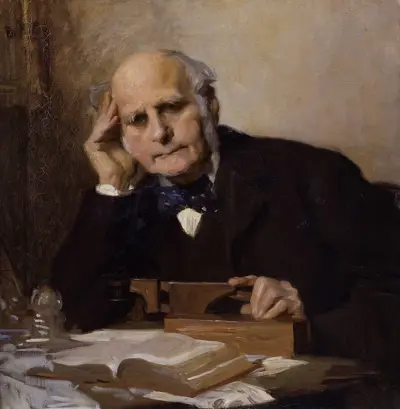
Sir Francis Galton, FRS, was an English Victorian era polymath: a statistician, sociologist, psychologist, anthropologist, tropical explorer, geographer, inventor, meteorologist, proto-geneticist, psychometrician and a proponent of social Darwinism, eugenics and scientific racism. He was knighted in 1909.
